How Much Can the Toyota Tundra Tow Compared to Competitors
The Toyota Tundra is a powerful full-size pickup truck with a towing capacity that reaches up to 10,200 pounds when properly equipped. It competes head-to-head with the Ford F150, Ram 1500, and Chevy Silverado in the half-ton truck segment. This guide breaks down the Tundra’s towing specs, compares it to key rivals, and shares practical tips for maximizing your towing experience.
This is a comprehensive guide about how much can the toyota tundra tow.
Key Takeaways
- Maximum Towing Power: The Toyota Tundra can tow up to 10,200 lbs when equipped with the right towing package and configuration.
- Competitive Edge: The Tundra holds its own against the Ford F150, Ram 1500, and Chevy Silverado in the half-ton towing class.
- Engine Matters: The 5.7L V8 engine delivers the best towing performance, while the i-FORCE MAX hybrid option adds torque for heavier loads.
- Trim Differences: Not every Tundra trim tows the same. Higher trims come with towing packages that boost capacity significantly.
- Safety First: Proper trailer setup, tongue weight distribution, and brake controllers are essential for safe towing.
- Related Toyota Models: The Sequoia and Tacoma also offer strong towing ability worth exploring if you need alternatives.
[FEATURED_IMAGE_PLACEHOLDER]
Toyota Tundra Towing Capacity: The Full Breakdown
The Toyota Tundra has been a staple in the full-size pickup truck market for years. When it comes to towing capacity, the Tundra holds its own against some tough competitors. But the exact number depends on several factors, including the engine, trim level, and towing package you choose.
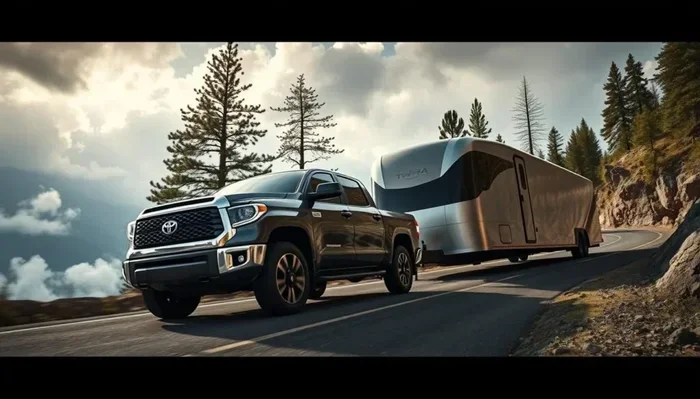
At its best, the Toyota Tundra can tow up to 10,200 pounds. That is enough to haul a large travel trailer, a fifth-wheel setup, or even a small boat. The base towing capacity starts lower, around 8,800 pounds, for models without the enhanced towing package. Understanding these numbers is key before you start shopping.
Towing Specs by Trim Level
Every Tundra trim offers a different towing experience. Here is a quick look at what you can expect across the lineup:
- SR: Base towing capacity of around 8,800 lbs with the standard 5.7L V8.
- SR5: Slightly higher at around 9,000 lbs depending on configuration.
- Limited: Comes with enhanced towing features, pushing capacity closer to 10,000 lbs.
- Platinum and 1794 Edition: Top-tier trims with the full towing package, reaching the max 10,200 lbs.
- TRD Pro: Built for tough jobs, towing capacity matches the Platinum at 10,200 lbs.
The i-FORCE MAX hybrid variant adds a nice twist. It delivers instant torque, which helps with towing stability and initial pull. This makes it easier to get heavy loads moving, especially on inclines. If you plan on towing often, the hybrid option is worth a serious look.
Toyota Tundra Towing vs. the Ford F150
The Ford F150 is the best-selling truck in America, and for good reason. It offers a wide range of engines, from the efficient 3.3L V6 to the powerful 5.0L V8 and the 3.5L EcoBoost. When you compare Toyota Tundra towing to the Ford F150, the numbers are close, but the details matter.
The Ford F150 2.7 EcoBoost can tow up to 13,500 pounds in certain configurations. That is a significant step up from the Tundra’s maximum. However, the F150’s towing capacity varies wildly depending on the engine you choose. The base 3.3L V6 maxes out around 7,600 lbs, which is less than the Tundra’s base offering.
Here is where it gets interesting. The Tundra’s 5.7L V8 is a naturally aspirated engine that delivers reliable, consistent power. The F150’s EcoBoost engines use turbocharging to squeeze out more power. Both approaches have pros and cons. The Tundra engine is simpler to maintain, while the EcoBoost offers more peak torque at lower RPMs.
For most everyday towing needs, the Toyota Tundra and Ford F150 are more than capable. If you need to tow extremely heavy loads regularly, the F150’s higher-end configurations give it an edge. But for the average truck user, the Tundra’s towing ability is more than enough.
Want a deeper look at Ford’s towing numbers? Check out our detailed guide on how much the Ford F150 2.7 EcoBoost can tow for a full breakdown.
Tundra Towing vs. Ram 1500 and Chevy Silverado
The Ram 1500 and Chevy Silverado are the other two heavy hitters in the half-ton truck segment. When you put Toyota Tundra towing capacity side by side with these models, the picture becomes clearer.
The Ram 1500 offers towing capacities ranging from about 6,200 lbs up to 12,750 lbs depending on the engine and configuration. The Hemi V8 models tow the heaviest loads. The Chevy Silverado 1500 follows a similar range, with its 6.2L V8 pushing towing past 13,000 lbs in certain setups.
Compared to both of these, the Tundra’s 10,200 lbs maximum sits in the middle of the pack. It is not the highest number, but it is competitive. The Tundra’s advantage lies in its reliability and lower maintenance costs over time. Many truck owners report fewer issues with the Tundra’s powertrain compared to competitors.
Also worth noting, the Toyota Tundra shares some DNA with the Toyota Sequoia SUV. If you are curious about how the Sequoia handles towing, we have a full comparison: can a Sequoia tow as much as a Tundra?
Quick Towing Comparison Table
| Truck | Base Towing (lbs) | Max Towing (lbs) | Best Engine for Towing |
|---|---|---|---|
| Toyota Tundra | 8,800 | 10,200 | 5.7L V8 / i-FORCE MAX |
| Ford F150 | 5,000 | 13,500 | 3.5L EcoBoost / 5.0L V8 |
| Ram 1500 | 6,200 | 12,750 | 5.7L Hemi V8 |
| Chevy Silverado 1500 | 6,000 | 13,300 | 6.2L V8 |
As you can see, the Tundra may not lead in raw numbers, but it offers strong, dependable towing that covers most needs. The other trucks pull ahead in maximum capacity, but they also come with higher price tags and more complex engines.
What Affects Your Toyota Tundra Towing Capacity
The numbers on paper do not tell the whole story. Several real-world factors impact how much your Tundra can actually tow safely. Understanding these variables helps you make smarter decisions.
Engine and Transmission
The 5.7L V8 remains the gold standard for Toyota Tundra towing. It produces 381 horsepower and 401 lb-ft of torque. The i-FORCE MAX hybrid adds electric motor torque, which gives a helpful boost during initial acceleration with a heavy load.
The 10-speed automatic transmission plays a big role too. It keeps the engine in the power band, which means better fuel economy and more consistent towing performance. Cheaper transmissions with fewer gears can struggle under heavy loads.
Payload and Cargo Weight
Here is something many people overlook. Your Tundra’s towing capacity is not the only number you need to watch. The payload capacity matters just as much. Payload is the weight of everything inside the truck, including passengers, cargo, and the truck itself.
If your truck is already carrying heavy gear in the bed, you have less capacity left for towing. Always subtract your cargo weight from the total payload rating before calculating safe towing limits. This simple step prevents overloading and keeps you safe on the road.
Trailer Type and Weight Distribution
Not all trailers are created equal. A travel trailer with a proper weight distribution system is much easier to tow than a poorly balanced load. The Tundra handles trailers well when the weight is distributed evenly across the axle.
Tongue weight is another critical factor. Aim for about 10 to 15 percent of your total trailer weight resting on the hitch. Too little tongue weight causes sway. Too much can overload the rear axle. A simple tongue weight scale makes this easy to check before every trip.
Towing Safety Tips for Tundra Owners
Towing a trailer changes how your truck drives. The extra weight affects braking, turning, and stability. Following a few key safety practices makes a huge difference.
- Install a brake controller: A brake controller lets you apply the trailer’s brakes independently. This is essential for safe stopping, especially with heavier loads.
- Use the right hitch: A weight-distribution hitch helps level your truck and trailer. It prevents the front of the truck from lifting and the rear from sagging.
- Check tire pressure: Proper tire pressure on both the truck and trailer improves fuel economy and handling. Underinflated tires are a leading cause of towing accidents.
- Allow extra stopping distance: A loaded truck takes longer to stop. Leave plenty of room between you and the vehicle ahead.
- Use side mirrors: Extended mirrors help you see the full width of your trailer. This is critical for lane changes and turns.
Many Tundra owners also add a towing package that includes a trailer sway control system. This feature automatically applies brakes to individual wheels if the trailer starts to sway. It is a small investment that pays off in peace of mind.
Common Towing Mistakes to Avoid
Even experienced truck owners make mistakes. Here are a few to watch out for:
- Overloading the trailer: Just because your truck can tow 10,200 lbs does not mean you should max it out every time. Staying at 80 percent of max capacity gives you a safety buffer.
- Ignoring the owner’s manual: Every Tundra model has specific towing guidelines in the manual. Skipping this step can void your warranty.
- Skipping the break-in period: New trucks need a break-in period before heavy towing. Check your manual for the recommended mileage before towing at full capacity.
- Neglecting maintenance: Towing puts extra stress on brakes, suspension, and the transmission. Stay on top of regular service intervals.
Which Tundra Trim Is Best for Towing?
If towing is your primary reason for buying a Tundra, you want the right trim. The Platinum and TRD Pro trims offer the best towing packages. They come with upgraded cooling systems, integrated trailer sway control, and reinforced suspension components.
The i-FORCE MAX hybrid trims are also excellent choices. The electric motor assist provides extra torque when you need it most, such as climbing steep grades or merging onto highways with a heavy load. The hybrid system also improves fuel economy during towing, which saves money on long trips.
For budget-conscious buyers, the SR5 trim with the 5.7L V8 still offers strong towing capability. You may need to add a towing package separately, but the base platform is solid. Check out our article on how much the Tacoma can tow if you are also considering a smaller Toyota truck option.
Final Thoughts on Toyota Tundra Towing
The Toyota Tundra is a capable, reliable half-ton truck that handles towing with confidence. Its maximum towing capacity of 10,200 pounds competes well in the crowded full-size pickup market. While trucks like the Ford F150 and Ram 1500 can tow slightly more in top configurations, the Tundra offers a compelling blend of durability, simplicity, and value.
Whether you are hauling a travel trailer to the mountains, towing a boat to the lake, or hauling equipment for work, the Tundra gets the job done. The key is to choose the right trim, install the proper towing equipment, and follow safe towing practices.
If you are still deciding between trucks, remember that towing capacity is only one piece of the puzzle. Reliability, maintenance costs, comfort, and resale value all matter. The Toyota Tundra excels in all of these areas, which is why it remains a top choice for truck buyers who take their towing seriously.
Before you make a final decision, visit your local Toyota dealer and test drive a Tundra with a trailer in tow. Nothing replaces the real-world experience of feeling how the truck handles under load. You will walk away with a much better sense of whether the Tundra is the right truck for your towing needs.
Frequently Asked Questions
How much can a Toyota Tundra tow at maximum capacity?
The Toyota Tundra can tow up to 10,200 pounds when equipped with the proper towing package and the 5.7L V8 or i-FORCE MAX engine. This capacity applies to the higher trims like Platinum, TRD Pro, and 1794 Edition.
Can a Toyota Tundra tow a 5th wheel trailer?
Yes, the Tundra can tow a 5th wheel trailer, but you need the right configuration. The maximum towing capacity for a 5th wheel setup is typically lower than a conventional trailer because of weight distribution over the rear axle. Always check your specific model’s owner manual for exact limits.
Does the Toyota Tundra hybrid tow as well as the V8?
The i-FORCE MAX hybrid offers strong towing performance thanks to instant electric torque. It matches the standard 5.7L V8 towing capacity of 10,200 pounds in most configurations. The hybrid also provides a smoother towing experience with better low-end torque.
What towing package do I need for maximum Tundra towing?
The Toyota Tundra Towing Package includes a weight-distribution hitch, trailer sway control, integrated brake controller, and upgraded cooling systems. This package is available on higher trims and is essential for reaching the maximum 10,200 lb towing limit safely.
How does the Toyota Tundra towing capacity compare to the Tacoma?
The Tundra tows significantly more than the Tacoma. While the Tacoma maxes out around 6,500 lbs depending on configuration, the Tundra can tow over 10,000 lbs. If you need serious towing power, the Tundra is the clear choice between the two.
Is 10,000 lbs of towing capacity enough for most needs?
For the majority of truck owners, 10,000 lbs is more than enough. This capacity covers most travel trailers, boat trailers, and equipment haulers. Only those towing very large fifth-wheel or gooseneck setups would need a heavier-duty truck.
=== CONCLUSION ===
The Toyota Tundra stands as a strong contender in the half-ton towing segment. With a maximum towing capacity of 10,200 pounds, it delivers the power and reliability that truck owners expect from the Toyota brand. While competitors like the Ford F150 and Ram 1500 may offer higher maximum numbers on paper, the Tundra’s real-world performance, low maintenance costs, and proven durability make it a smart choice.
Choose the right trim, invest in proper towing equipment, and always prioritize safety. The Tundra will serve you well whether you are towing for work or play. Toyota Tundra towing capacity gives you the confidence to hit the road with your load, knowing your truck is built for the job.