How Many Cars Does Tesla Make a Year and Why It Matters
Tesla produces roughly 1.8 million vehicles annually, making it one of the most productive EV manufacturers on the planet. The company builds cars across multiple factories worldwide, from Fremont to Shanghai. Understanding Tesla’s production numbers helps investors, buyers, and fans see where the company stands in the EV market. Production has grown fast, but challenges like supply chains and factory upgrades still shape output.
Tesla has changed the way people think about cars. From electric sedans to SUVs, the company has built a massive global brand. But one question keeps coming up: how many cars does Tesla make a year? The answer tells a bigger story about the future of electric vehicles, manufacturing, and the auto industry as a whole.
When you look at Tesla’s production numbers, you see a company that has scaled incredibly fast. In just over a decade, Tesla went from building a few thousand cars a year to nearly two million. That kind of growth is rare in any industry. And it matters whether you are an investor, a car buyer, or just someone curious about EVs.
So let us break down everything you need to know about Tesla’s annual production. We will look at numbers by model, by factory, and by year. We will also explore why these numbers matter and what they mean for the future of electric vehicle manufacturing.
Key Takeaways
- Annual Production Volume: Tesla makes around 1.8 million cars per year across all models and factories.
- Model Y Leads the Way: The Model Y is Tesla’s best-selling and most-produced vehicle globally.
- Global Factories Drive Output: Fremont, Shanghai, Berlin, and Texas each play a big role in Tesla’s annual production.
- Production Has Grown Fast: Tesla’s output has more than doubled in just a few years.
- Challenges Still Exist: Supply chain issues and factory ramp-ups can slow production targets.
- Future Plans Are Bold: New models like the Cybertruck and next-gen platform aim to boost annual output even more.
📑 Table of Contents
How Many Cars Does Tesla Make a Year
The short answer is that Tesla produces around 1.8 million vehicles per year as of recent reports. But the full picture is more interesting than that single number. Production has grown steadily over the past several years, with some big jumps along the way.
In 2023, Tesla delivered about 1.81 million cars worldwide. That was a slight increase from 2022. The company aims to keep growing this number every year. To put it in perspective, Tesla’s annual output now rivals some of the biggest traditional automakers in the world.
Here is a quick look at Tesla’s recent production and delivery numbers:
- 2020: Around 500,000 vehicles produced and delivered
- 2021: Roughly 936,000 vehicles produced and delivered
- 2022: About 1.31 million vehicles produced and delivered
- 2023: Approximately 1.81 million vehicles produced and delivered
These numbers show a clear upward trend. Tesla has consistently beaten its own production targets, even when the auto industry faced big disruptions. The company’s ability to scale so quickly is one of its biggest competitive advantages.
Why Production Numbers Matter
You might wonder why Tesla’s annual output is such a big deal. The truth is, production numbers affect everything. They influence stock prices, market share, and the company’s ability to meet demand. When Tesla ramps up production, it sends a signal to the market that the company is growing and expanding.
For buyers, production numbers matter too. Higher output means more cars are available. That can lead to shorter wait times and more competitive pricing. For the EV industry as a whole, Tesla’s production success pushes other automakers to accelerate their own electric vehicle plans.
Tesla’s Production by Model
Tesla does not just make one car. The company produces several models, and each one has a different production volume. Understanding which models drive the most output helps explain the bigger picture of how many cars does Tesla make a year.
Model Y: The Production King
The Model Y is Tesla’s best-selling vehicle. It is a compact SUV that appeals to families and everyday drivers. In 2023, the Model Y became the best-selling car in the world by volume, beating out traditional gas-powered SUVs.
Most of Tesla’s annual production goes toward the Model Y. The car is built at every Tesla factory around the world. Its popularity drives a huge chunk of the company’s yearly output. If you are wondering what Tesla makes the most of, the answer is almost certainly the Model Y.
Model 3: The Sedan That Started It All
The Model 3 was Tesla’s first mass-market electric car. It launched in 2017 and quickly became a hit. While the Model Y has since overtaken it in production volume, the Model 3 still makes up a significant portion of Tesla’s annual output.
Many buyers choose the Model 3 for its range and affordability. It remains one of the most popular electric sedans on the market. Tesla continues to produce the Model 3 at its Fremont and Shanghai factories.
Model S and Model X: The Premium Options
The Model S and Model X are Tesla’s luxury vehicles. They cost more and sell in smaller numbers compared to the Model 3 and Model Y. But they still contribute to Tesla’s overall production numbers.
These models are important for Tesla’s brand image. They show that electric cars can be high-performance and premium. While they do not make up the bulk of production, they help Tesla compete with luxury automakers like Porsche and Mercedes-Benz.
Cybertruck: The Newcomer
The Cybertruck is Tesla’s newest addition to the lineup. It is a futuristic pickup truck that has generated massive buzz. Production of the Cybertruck started in late 2023, but volumes are still relatively low.
Tesla plans to ramp up Cybertruck production over the next few years. If the company meets its targets, the Cybertruck could become a meaningful part of annual output. For now, it is still a small piece of the overall production puzzle.
Tesla’s Global Manufacturing Network
Tesla does not rely on just one factory. The company operates multiple manufacturing plants across the globe. Each factory plays a role in answering the question of how many cars does Tesla make a year.
Fremont Factory: The Original Hub
The Fremont factory in California was Tesla’s first major manufacturing plant. It was once a joint venture with Toyota and General Motors. Tesla took over the facility in 2010 and transformed it into a high-tech EV factory.
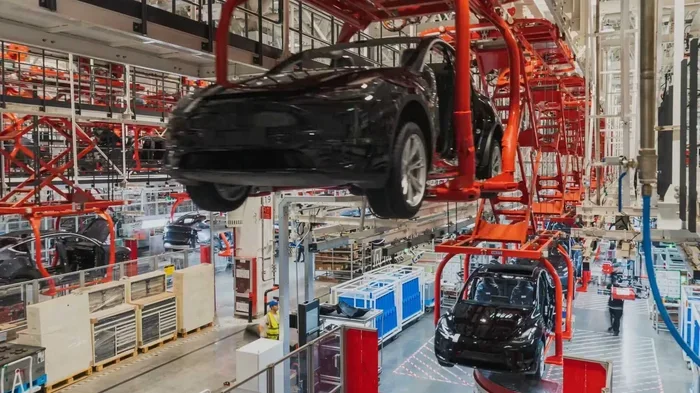
Fremont produces the Model S, Model X, Model 3, and Model Y. It is the company’s oldest and most experienced factory. The facility can produce several hundred thousand vehicles per year, making it a backbone of Tesla’s global output.
Shanghai Gigafactory: The Production Powerhouse
Tesla’s Shanghai factory, known as Gigafactory Shanghai, is the company’s largest production facility. It builds the Model 3 and Model Y for the Chinese market and for export.
Shanghai has become a production juggernaut. It can churn out vehicles faster than almost any other Tesla factory. The factory’s efficiency and low production costs give Tesla a major advantage in the world’s largest auto market.
Berlin and Texas: New Frontiers
Tesla opened Gigafactory Berlin in 2022 and Gigafactory Texas in 2022. Both factories produce the Model Y. Berlin serves the European market, while Texas serves North America.
These newer factories are still ramping up. They face their own set of challenges, from regulatory approvals to workforce training. But once they reach full capacity, they will add significantly to Tesla’s annual production numbers.
Giga Texas and the Cybertruck
Giga Texas is also the home of Cybertruck production. The factory was specifically designed to handle the unique manufacturing needs of the Cybertruck’s stainless steel body. As Cybertruck production scales, Texas will become an even more important part of Tesla’s global network.
Why Tesla’s Production Numbers Matter
Understanding how many cars does Tesla make a year goes beyond just the numbers. The production data tells a story about the company’s health, its market position, and its future potential.
Impact on Stock Price
Tesla’s stock price often moves based on production news. When the company reports strong output numbers, investors get excited. When production falls short of targets, the stock can drop.
This is because production numbers are a proxy for growth. Higher production means more revenue, more market share, and more influence in the EV space. Investors watch quarterly production reports closely, and they use the data to make buying and selling decisions.
Market Share in the EV Industry
Tesla’s production volume gives it a leading position in the electric vehicle market. The company sells more EVs than any other automaker in the world. This dominance is not just about brand recognition. It is about sheer output.
When Tesla produces more cars, it sets the standard for the industry. Other automakers look to Tesla’s factories and production methods as a benchmark. Tesla’s ability to scale quickly forces competitors to accelerate their own EV programs.
Meeting Global Demand
One of the biggest challenges in the auto industry is matching production to demand. Tesla has done a remarkable job of this. The company consistently builds enough cars to meet or exceed consumer demand.
But demand is not static. It changes based on economic conditions, new model launches, and competition. Tesla’s production team has to stay flexible and responsive. The company’s ability to adjust output quickly is one of its greatest strengths.
Quick Tips: How to Read Tesla Production Reports
- Look at both production and delivery numbers. They are not always the same. Production is how many cars are built. Delivery is how many are sold and handed to customers.
- Compare year-over-year data. This shows growth trends and helps you spot patterns.
- Watch for seasonal dips. Production often slows in the first quarter of the year.
- Check which models are driving the numbers. The Model Y usually accounts for the largest share.
- Consider factory-specific output. Shanghai and Fremont are the biggest contributors.
Production Challenges and Milestones
Tesla’s journey to its current production levels has not been smooth. The company has faced many challenges along the way. But each challenge has also been a learning opportunity.
The Early Struggles
When Tesla first started mass production with the Model S, the company struggled to build cars at scale. The early years were marked by delays, quality issues, and production bottlenecks. Many experts doubted whether Tesla could ever produce cars in large numbers.
But Tesla proved the doubters wrong. The company invested heavily in automation and factory improvements. It learned from its mistakes and kept pushing forward. Today, Tesla’s production process is one of the most advanced in the auto industry.
Recent Production Milestones
Tesla has hit several major production milestones in recent years. Here are some of the most notable ones:
- One millionth Model 3 produced: Tesla reached this milestone in 2020, showing the company could scale its most popular model.
- Shanghai factory hits 1,000 vehicles per day: This was a huge achievement for the company’s newest factory.
- Giga Texas starts Cybertruck production: A major milestone for Tesla’s newest vehicle.
- Berlin factory reaches full capacity: This expanded Tesla’s European production capabilities.
Common Mistakes People Make About Tesla Production
- Confusing production with deliveries. A car that is produced but not yet delivered is not the same as a sold car.
- Assuming production numbers are always accurate. Tesla sometimes revises its estimates after the fact.
- Ignoring regional differences. Production in Shanghai is not the same as production in Fremont.
- Overestimating short-term growth. Tesla’s long-term trend is up, but quarterly numbers can fluctuate.
Expert Insights: What Industry Analysts Say
Industry analysts closely watch Tesla’s production numbers because they provide insight into the company’s future. Many analysts believe Tesla has the potential to produce 3 million or more vehicles per year by 2030. This would require significant expansion of the current factory network.
Some experts point to the new next-generation platform that Tesla is developing. This platform is expected to be cheaper and faster to build on. It could dramatically increase production efficiency and lower costs per vehicle.
Others caution that scaling production is not just about building more factories. It requires a reliable supply chain, skilled workers, and consistent quality control. Tesla has shown it can handle these challenges, but growth always brings new complexities.
What the Future Holds for Tesla Production
Looking ahead, Tesla’s production future looks bright. The company has several plans in the works that could push annual output even higher. Here is what we can expect in the coming years.
New Factories and Expansion
Tesla has hinted at building additional factories in new markets. Mexico and India are two countries where the company has expressed interest. A factory in either location would add to Tesla’s global production capacity and help answer how many cars does Tesla make a year with even bigger numbers.
Tesla is also expanding its existing factories. Fremont is undergoing continuous upgrades. Shanghai keeps adding capacity. Berlin and Texas are still ramping up. Each expansion adds to the company’s total annual output.
Next-Generation Vehicle Platform
Tesla is developing a next-generation platform that promises to be more efficient and cheaper to produce. This platform could reduce manufacturing costs by up to 50%. Lower costs mean Tesla can build more cars for the same amount of money.
The new platform is expected to underpin a future compact Tesla vehicle. This model could be priced lower than the Model 3, making electric cars accessible to more buyers. Higher affordability usually means higher demand, which means more production.
The Cybertruck Factor
The Cybertruck represents a new chapter for Tesla production. The vehicle’s unique design requires specialized manufacturing processes. As Tesla refines these processes, Cybertruck production is expected to grow significantly.
If the Cybertruck becomes a mainstream success, it could add hundreds of thousands of vehicles to Tesla’s annual output. The pickup truck market is massive, and Tesla is positioning itself to capture a big share of it.
Key Takeaways
- Annual Production Volume: Tesla makes around 1.8 million cars per year, and the number keeps growing.
- Model Y Drives the Most Output: It is Tesla’s best-selling and most-produced vehicle globally.
- Factories Around the World: Fremont, Shanghai, Berlin, and Texas each contribute to annual production.
- Production Has Grown Rapidly: Tesla’s output has more than tripled in just five years.
- Challenges Are Part of the Journey: Supply chain issues and factory ramp-ups affect production targets.
- The Future Is Ambitious: New factories, new platforms, and new models aim to push annual output even higher.
Conclusion
So, how many cars does Tesla make a year? The answer is around 1.8 million, and that number is only going up. Tesla has proven itself as a force in the auto industry. The company’s ability to scale production quickly and efficiently sets it apart from traditional automakers and even other EV startups.
From the Model 3 to the Cybertruck, every Tesla vehicle adds to the company’s impressive annual output. The global manufacturing network, spanning four continents, ensures that Tesla can serve customers worldwide. And the company’s plans for the future suggest even bigger numbers are on the horizon.
Whether you are tracking Tesla for investment reasons, considering a purchase, or simply fascinated by the EV revolution, the production numbers tell an important story. They show a company that is not just keeping up with the transition to electric vehicles but is actively leading it. Tesla’s production journey is far from over, and the next chapter looks even more exciting.
The takeaway is simple. Tesla is building cars at a scale that the world has never seen for an electric vehicle manufacturer. And as the company continues to expand its factories and refine its processes, those numbers will only get bigger. The age of electric driving is here, and Tesla is making it happen at a remarkable pace.
Frequently Asked Questions
How many cars does Tesla make a day?
Tesla produces roughly 5,000 to 6,000 vehicles per day across all its factories. This number can vary based on the model, factory location, and time of year. Shanghai is the most productive single factory, contributing a large share of daily output.
What is Tesla’s biggest selling model?
The Model Y is Tesla’s best-selling vehicle. It has been the best-selling car in the world by volume in recent years. The Model 3 is also a top seller, but the Model Y has overtaken it in total production and deliveries.
Does Tesla produce cars in China?
Yes, Tesla operates Gigafactory Shanghai, which is one of its largest and most productive factories. The Shanghai factory builds the Model 3 and Model Y for both the Chinese market and export markets around the world.
How has Tesla’s production grown over the years?
Tesla’s annual production has grown from about 500,000 vehicles in 2020 to nearly 1.8 million in 2023. This represents more than a threefold increase in just three years. The growth has been driven by new factories, model expansion, and improved manufacturing processes.
Will Tesla produce more than 2 million cars a year?
Tesla has stated its goal to reach 20 million vehicles per year by 2030. While that is a long-term target, the company is on a path to significantly increase its current output. New factories and the next-generation platform will play key roles in achieving this ambitious goal.
Why do Tesla’s production numbers sometimes get revised?
Tesla sometimes revises its production estimates after the quarter ends. This can happen due to supply chain disruptions, factory downtime, or logistical challenges. The company aims for transparency and typically provides updated figures in its quarterly earnings reports.