Is an F-550 a 2-Ton Truck The Real Deal Explained
The Ford F-550 is often called a 2-ton truck, but the real answer depends on how you measure it. This heavy-duty pickup falls into the Class 3 or Class 4 category based on its Gross Vehicle Weight Rating. Understanding the F-550’s true classification helps buyers make smarter decisions about towing, payload, and licensing requirements. Let us break down the facts clearly.
So, is an F-550 a 2-ton truck? That is a question a lot of truck shoppers ask, and for good reason. The Ford F-550 sits in a confusing spot. It feels bigger and stronger than a standard pickup, but the numbers do not always line up with what people expect. Many folks assume it is a simple 2-ton truck, and that is partly true. But the full picture is more nuanced than that.
In this article, we will walk through everything you need to know. We will look at the Ford F-550 classification, payload numbers, towing capacity, and how it stacks up against other trucks in the Ford Super Duty lineup. By the end, you will have a clear answer. More importantly, you will understand why the answer is what it is. Let us get into it.
Key Takeaways
- The F-550 is not always a 2-ton truck: Its classification depends on GVWR and configuration.
- Ford Super Duty trucks like the F-550 sit between Class 3 and Class 4: This is a key detail many buyers miss.
- Payload and towing numbers vary widely: Options like chassis cab vs. crew cab change everything.
- Licensing requirements can differ by state: A 2-ton designation may affect what you can legally drive.
- The F-550 is built for serious work: It is a commercial-grade truck, not just a heavy-duty pickup.
- Understanding truck classes helps you compare: Class 3, Class 4, and Class 5 trucks each serve different needs.
- Always check the specific model year and trim: Specs change, and so does the classification.
📑 Table of Contents
- What Does It Mean When People Call the F-550 a 2-Ton Truck?
- Understanding the Ford F-550 Classification
- How the F-550 Compares to Other Ford Super Duty Trucks
- Payload Capacity: What Can the F-550 Actually Carry?
- Towing Capacity: How Much Can the F-550 Pull?
- Is an F-550 a 2-Ton Truck for Licensing and Registration?
- Who Should Buy an F-550?
- Key Takeaways
- Conclusion
What Does It Mean When People Call the F-550 a 2-Ton Truck?
The term “2-ton truck” comes from an old classification system. Back in the day, trucks were labeled by how much they could carry in their bed. A half-ton truck could haul about 1,000 pounds. A one-ton truck could carry roughly 2,000 pounds. So a 2-ton truck would mean double that, right? Not exactly. The naming system is not perfectly precise, and that is where confusion starts.
When people refer to the Ford F-550 as a 2-ton truck, they are usually talking about its rough payload range. The F-550 can carry between 4,000 and 6,000 pounds of cargo depending on the setup. That is far more than a half-ton F-150. But it also depends on whether you are looking at a standard cab, a crew cab, or a chassis cab configuration. Each one changes the numbers significantly.
Where the “2-Ton” Label Comes From
The 2-ton label is not an official government designation. It is more of a shorthand used in the trucking world. The real classification system uses Gross Vehicle Weight Rating, or GVWR. Trucks with a GVWR between 8,501 and 10,000 pounds fall into Class 3. Trucks above 10,000 pounds move into Class 4 or Class 5 territory. The F-550 straddles these categories, which is why people call it a 2-ton truck in casual conversation.
Here is a quick look at how the old naming system compares to modern truck classes:
- Half-ton: Class 1 and Class 2 trucks like the Ford F-150
- Three-quarter ton: Class 2 and Class 3 trucks like the Ford F-250
- One-ton: Class 3 and Class 4 trucks like the Ford F-350 and F-450
- 2-ton: A loose term that often refers to the F-550 range
As you can see, the old “ton” system is a rough guide. It does not capture the full picture of what a truck can do. That is why we need to look at the actual numbers.
Understanding the Ford F-550 Classification
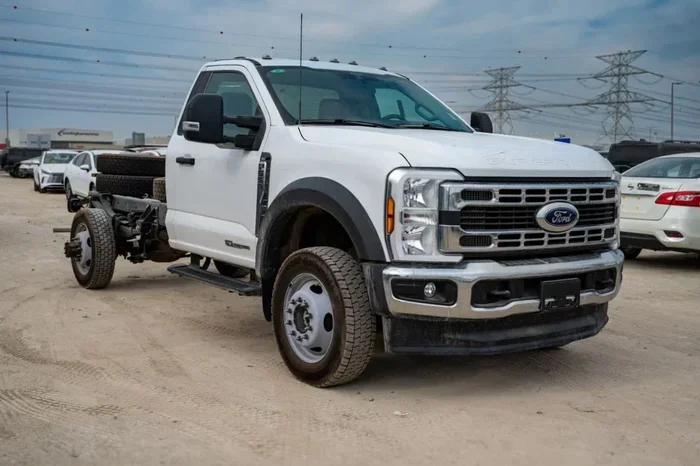
The Ford F-550 belongs to the Ford Super Duty family. This lineup includes the F-250, F-350, F-450, F-550, and F-650. Each truck is built for different levels of work and hauling. The F-550 sits toward the heavier end of the Super Duty range, which is why it gets the 2-ton label. But its official classification depends on how it is configured.
When you look at a standard Ford F-550 pickup truck, it usually falls into Class 3. The GVWR for most configurations lands between 9,000 and 10,000 pounds. However, when you move to a chassis cab version or add heavy-duty options, the GVWR can push past 14,000 pounds. That puts it in Class 5 territory. So the answer to “is an F-550 a 2-ton truck” really depends on the specific model and setup.
GVWR: The Number That Really Matters
GVWR stands for Gross Vehicle Weight Rating. It is the maximum total weight of the truck, including the vehicle itself, passengers, cargo, and fuel. This number is set by the manufacturer and is stamped on the door jamb sticker. It is the single most important number for understanding where a truck fits in the classification system.
For the Ford F-550, here are the general GVWR ranges you will see:
- Standard pickup configuration: 9,000 to 10,000 pounds (Class 3)
- Chassis cab with heavy options: 12,000 to 14,000+ pounds (Class 4 or 5)
- With aftermarket additions: Can exceed 14,000 pounds depending on setup
The takeaway here is simple. The F-550 is not just one thing. It is a platform that can be built many different ways. And each build changes its official classification. This is why the 2-ton label is both helpful and misleading at the same time.
How the F-550 Compares to Other Ford Super Duty Trucks
To really understand where the F-550 stands, it helps to compare it to its siblings in the Ford Super Duty lineup. Each truck in the family serves a slightly different purpose, and the differences are significant.
F-250 vs F-350 vs F-550
The Ford F-250 is often called a three-quarter-ton truck. It has a GVWR around 9,000 pounds and a payload capacity of roughly 3,000 to 4,000 pounds. The Ford F-350 is commonly labeled a one-ton truck. Its GVWR ranges from about 10,000 to 14,000 pounds depending on the configuration. The F-550 steps up from there, with even higher payload and towing numbers.
Here is a side-by-side comparison of the three trucks:
- Ford F-250: Half-ton to three-quarter-ton classification. GVWR around 9,000 lbs. Payload up to 4,200 lbs. Towing up to 20,000 lbs.
- Ford F-350: One-ton classification. GVWR from 10,000 to 14,000 lbs. Payload up to 7,640 lbs. Towing up to 37,000 lbs.
- Ford F-550: 2-ton to heavy-duty classification. GVWR from 9,000 to 14,000+ lbs. Payload up to 7,640 lbs. Towing up to 35,500 lbs.
Notice how the F-550 and F-350 overlap in some areas. That is because the F-550 is essentially a beefed-up version of the F-350 chassis. The frame is stronger, the axles are heavier duty, and the suspension is built for even more abuse. This makes the F-550 a popular choice for commercial work, fleet operations, and serious hauling jobs.
Why the F-550 Stands Out
The Ford F-550 is not just a bigger F-350. It is a different tool for different jobs. While the F-350 is great for towing fifth wheels and hauling equipment, the F-550 is often used for commercial applications. Think box trucks, utility bodies, dump trailers, and flatbed setups. The chassis cab versions of the F-550 are incredibly popular with contractors, municipalities, and utility companies.
If you are shopping for a truck and wondering whether the F-550 is the right choice, ask yourself what you need it for. For heavy-duty towing and daily driving, the F-350 might be enough. For commercial work and maximum payload, the F-550 is hard to beat.
Payload Capacity: What Can the F-550 Actually Carry?
This is where things get really interesting. The payload capacity of the Ford F-550 is one of the main reasons people buy it. But the numbers vary a lot based on the configuration. Let us break it down.
Payload Numbers by Configuration
A standard Ford F-550 pickup with a long bed and heavy-duty options can carry around 5,000 to 7,640 pounds in the bed. That is a massive amount of cargo. For comparison, the Ford F-150 maxes out around 3,200 pounds in most configurations. The F-550 can carry more than double that.
Here are some real-world payload examples:
- Standard cab, long bed, 8-foot bed: Payload around 5,000 to 6,500 lbs
- Crew cab, short bed, heavy-duty package: Payload around 4,500 to 5,500 lbs
- Chassis cab, no bed: Payload can exceed 7,000 lbs depending on axle setup
These numbers assume you are staying within the GVWR limits and not exceeding the gross axle weight ratings. Always check the door jamb sticker and the owner’s manual for the exact numbers for your specific truck. Overloading a truck is dangerous and can void your warranty.
Quick Tips for Maximizing Payload
Want to get the most out of your F-550’s payload capacity? Here are some practical tips that actually work.
- Choose the right cab style: A standard cab leaves more weight capacity for cargo than a crew cab.
- Opt for a longer bed: Longer beds spread weight more evenly and can handle more payload.
- Watch your axle ratio: A higher axle ratio can affect payload ratings. Check the spec sheet carefully.
- Skip unnecessary options: Every added feature adds weight. Less weight in the truck means more weight available for cargo.
- Check the tire rating: Tires rated for higher loads can support more payload on the axles.
These small choices add up. They can mean the difference between a truck that is maxed out and one that still has room to spare.
Towing Capacity: How Much Can the F-550 Pull?
Towing is one of the biggest reasons people buy heavy-duty trucks. The Ford F-550 is a serious towing machine. Its towing capacity depends on the engine, transmission, axle ratio, and towing package installed.
F-550 Towing Numbers
Most Ford F-550 models can tow between 21,000 and 35,500 pounds when properly equipped. The highest towing numbers come from the 6.7L Power Stroke diesel engine paired with the proper towing package and a gooseneck or fifth wheel hitch setup.
Here is a quick look at the towing numbers by engine option:
- 6.2L Gasoline V8: Towing up to 21,000 lbs
- 6.7L Power Stroke Diesel V8: Towing up to 35,500 lbs
- With gooseneck hitch: Adds several thousand pounds of towing capacity over a bumper hitch
The diesel engine is the clear winner for towing. It delivers more torque at lower RPMs, which is exactly what you need when hauling heavy loads. The gasoline engine is still powerful, but it falls short of the diesel in raw towing capability.
Common Mistakes People Make When Towing with an F-550
Even with a truck as capable as the F-550, mistakes happen. Here are some common errors to avoid.
- Ignoring the GVWR: Just because the truck can tow 35,000 pounds does not mean you can load it to the max. Your cargo, passengers, and fuel all count toward the GVWR.
- Skipping the proper hitch: A bumper hitch limits towing capacity. A gooseneck or fifth wheel hitch is essential for maxing out the F-550’s towing power.
- Not checking axle weight: The tires and axles have their own weight limits. Exceeding these can be dangerous and expensive.
- Forgetting about tongue weight: Proper tongue weight (usually 10-15% of trailer weight) is critical for safe towing.
Taking the time to set up your truck correctly makes a huge difference. It keeps you safe on the road and protects your investment.
Is an F-550 a 2-Ton Truck for Licensing and Registration?
This is a question that does not get asked enough, but it matters a lot. In many states, trucks over a certain weight require a special license or registration. The 2-ton label can affect what you need to legally drive and register your truck.
Do You Need a Special License to Drive an F-550?
In most states, a regular Class C driver’s license is enough to drive a Ford F-550. This is because the GVWR of most F-550 configurations stays under 26,000 pounds. However, if you are running a chassis cab version or adding heavy aftermarket equipment, you might push past that threshold. Always check your state’s specific laws before buying or modifying your truck.
Some states also have different rules for commercial use versus personal use. If you plan to use the F-550 for work, you may need a commercial driver’s license or a commercial vehicle registration. These requirements vary widely, so do your homework before you hit the road.
Registration and Insurance Considerations
Heavier trucks often come with higher registration fees and insurance premiums. The F-550 is no exception. Because it sits in a higher weight class than a standard pickup, expect to pay more in both areas. This is something many first-time F-550 buyers do not plan for, and it can add hundreds of dollars per year to the cost of ownership.
Pro tip: When shopping for insurance, make sure to tell your agent exactly what you plan to use the truck for. Commercial use and personal use are rated very differently. Getting the right classification from day one saves you headaches later.
Who Should Buy an F-550?
Now that we have covered the technical details, let us talk about who the Ford F-550 is actually for. This is not a truck for everyone, and that is okay. It is a specialized tool built for specific needs.
The Ford F-550 is ideal for:
- Contractors and tradespeople: Who need maximum payload and the ability to haul heavy equipment.
- Commercial fleet operators: Who rely on their trucks for daily work and need reliability under heavy loads.
- Farmers and ranchers: Who need a versatile truck that can handle everything from livestock hauling to equipment transport.
- Towing enthusiasts: Who want the maximum towing capacity available in a pickup truck platform.
- Municipal and government agencies: Who need work trucks for utilities, road maintenance, and emergency response.
If you do not fall into one of these categories, a Ford F-250 or F-350 might be a better fit. The F-550 is a workhorse, and it shines when put to work. For weekend towing or light-duty hauling, a lighter-duty truck will save you money on fuel, insurance, and registration.
Expert Insight: The Real Value of the F-550
According to industry experts, the Ford F-550 offers one of the best values in the heavy-duty truck segment for commercial users. Its combination of payload capacity, towing power, and durability makes it a go-to choice for fleet buyers. The aftermarket support is also excellent, with a huge market for upfit kits, bodies, and accessories designed specifically for the F-550 platform.
One thing to keep in mind: the F-550 is not a comfortable daily driver for most people. The ride is stiff, the fuel economy is low, and the truck is large and difficult to park in tight spaces. If your primary use is commuting and light hauling, a lighter-duty truck will serve you better.
Key Takeaways
- The F-550 is not always a 2-ton truck: Its classification depends on GVWR and configuration, ranging from Class 3 to Class 5.
- Payload capacity is the F-550’s strong suit: With up to 7,640 pounds of payload, it handles serious hauling jobs with ease.
- Towing capacity reaches up to 35,500 pounds: When equipped with the diesel engine and proper hitch setup.
- Licensing requirements vary by state: Most states allow standard licensing for F-550 pickup configurations.
- The F-550 is a commercial-grade workhorse: It is built for fleet use, contractors, and heavy-duty applications.
- Compare it to the F-250 and F-350: Each truck in the Super Duty lineup serves a different purpose and buyer need.
- Check the specific specs for your model: Year, trim, and configuration all affect classification, payload, and towing numbers.
Conclusion
So, is an F-550 a 2-ton truck? The honest answer is: it depends. The Ford F-550 can be classified as a 2-ton truck in casual conversation, but its official classification ranges from Class 3 to Class 5 depending on the configuration. The truck’s GVWR, payload capacity, and towing numbers all play a role in determining where it fits in the truck classification system.
What is clear is that the F-550 is one of the most capable and versatile trucks Ford makes. Whether you need it for commercial work, heavy towing, or hauling large equipment, the F-550 delivers. Just make sure you understand what you are buying and that it matches your actual needs.
If you are in the market for a heavy-duty truck, the Ford F-550 deserves a close look. Do your research, compare it to the F-350 and F-450, and talk to your local dealer about the specific configuration you want. The more you know, the better decision you will make. And that is what this whole article is about helping you do.
Take the time to understand the numbers. Check the GVWR, look at the payload and towing specs, and consider how you will actually use the truck. When you do that, you will find the right Ford Super Duty truck for your needs, whether that is the F-550 or another model in the lineup.
Frequently Asked Questions
Is an F-550 considered a 1-ton or 2-ton truck?
The F-550 is commonly referred to as a 2-ton truck in casual use, but its official classification depends on the GVWR. Most standard F-550 pickups fall into Class 3, while chassis cab versions can reach Class 4 or 5. The “2-ton” label is a rough estimate, not an official designation.
What is the difference between an F-350 and an F-550?
The Ford F-550 has a heavier-duty frame, stronger axles, and higher payload and towing capacity than the F-350. The F-350 is more popular for personal and light commercial use, while the F-550 is built for serious commercial and fleet applications. The F-550 also has a higher GVWR ceiling in many configurations.
Can you drive an F-550 with a regular driver’s license?
In most states, yes. A standard Class C driver’s license is sufficient for operating an F-550 pickup truck. However, if the truck’s GVWR exceeds 26,000 pounds or is used for commercial purposes, additional licensing or registration may be required. Always check your local state laws.
How much does a Ford F-550 cost?
New Ford F-550 prices start around $40,000 for a basic chassis cab and can exceed $70,000 for fully loaded configurations with diesel engines and premium options. Used F-550 prices vary widely depending on the year, mileage, and condition, typically ranging from $20,000 to $50,000.
Is the F-550 a good truck for everyday driving?
The F-550 is not ideal for everyday driving for most people. It is large, stiff-riding, and has poor fuel economy compared to lighter trucks. However, if your daily use involves heavy hauling or towing, it can work well. Most people find the F-250 or F-350 more practical for daily use.
What engine comes in the Ford F-550?
The Ford F-550 offers two engine options: a 6.2L gasoline V8 and a 6.7L Power Stroke turbo diesel V8. The gasoline engine is great for lighter-duty work and offers lower upfront cost. The diesel engine delivers significantly more torque and towing capacity, making it the preferred choice for heavy-duty applications.