Is It OK to Drive With TRAC Off What You Need to Know
Is It OK to Drive With TRAC Off is an essential topic that provides valuable insights.
Key Takeaways
- Understanding Is It OK to Drive With TRAC Off: Provides essential knowledge
📑 Table of Contents
- What Is TRAC and How Does It Work?
- When Should You Turn TRAC Off?
- Is It Safe to Drive With TRAC Off?
- Common TRAC Off Warning Signs and What They Mean
- TRAC Off vs. Other Safety Systems in Your Toyota
- Expert Tips for Using TRAC Correctly
- Common Mistakes People Make With TRAC Off
- Key Takeaways
- Frequently Asked Questions
- Conclusion
What Is TRAC and How Does It Work?
TRAC stands for Traction Control. It is a standard safety feature in Toyota vehicles. The system uses sensors to monitor wheel speed. When it detects that a wheel is spinning faster than the others, it steps in. It reduces engine power or applies the brakes to that wheel. This helps you maintain control on slippery surfaces.
The TRAC system works closely with your vehicle’s ABS (Anti-lock Braking System). Together, they help you stay stable. You may also hear the term VSC, which stands for Vehicle Stability Control. These systems are all connected. They share data from wheel speed sensors and steering angle sensors. The goal is simple: keep your car moving the way you intend.
When TRAC is active, you may notice it working. The system might reduce engine power when you accelerate too hard on ice. It might pulse the brakes when a rear wheel starts to slip. You usually cannot feel the system working directly. But you will see the TRAC warning light blink on the dash when it is active.
Key Components of the TRAC System
- Wheel Speed Sensors: These monitor how fast each wheel is spinning.
- ABS Modulator: This applies braking force to individual wheels.
- Engine Control Unit: This reduces power when wheel spin is detected.
- Dashboard Warning Light: This alerts you when TRAC is active or has a problem.
- Steering Angle Sensor: This helps the system understand your intended direction.
Understanding these parts helps you see why TRAC matters. Each component plays a role in keeping you safe. When one fails or is turned off, the system cannot do its job.
When Should You Turn TRAC Off?
There are specific situations where turning off TRAC makes sense. It is not something you should do while driving on a normal highway. But in certain conditions, disabling traction control can actually help you.
Driving on Deep Snow or Ice
If your car is stuck in deep snow, TRAC can actually work against you. The system tries to stop wheel spin. But sometimes, a little wheel spin is exactly what you need to get unstuck. When TRAC is off, your wheels can spin freely. This lets you rock the car back and forth to gain momentum. Many Toyota owners keep this in mind during winter months.
Driving Through Mud or Loose Gravel
Similar to snow, mud and loose gravel can cause TRAC to intervene too much. The system may cut engine power when you need it. On a muddy trail, you want full power available. Turning TRAC off lets the wheels spin without intervention. This is common among drivers who use their Toyota for off-road adventures.
When Your Vehicle Is Stuck
If one or more wheels are on a slippery surface and others are on solid ground, TRAC may not help. It might limit power to the wheels with traction. This can keep you stuck longer. Disabling TRAC allows power to flow to all wheels. This can help you drive out of a difficult spot.
During Vehicle Recovery or Towing
If you are towing another vehicle or recovering a stuck car, TRAC can interfere. The system may detect abnormal wheel speeds and cut power. This can make towing more difficult. Turning it off removes this interference. Always remember to turn TRAC back on once you are done.
Is It Safe to Drive With TRAC Off?
This is the big question most drivers ask. The answer is not a simple yes or no. It depends entirely on the driving conditions. Let us break this down clearly.
Safe Conditions to Drive With TRAC Off
In some situations, driving with TRAC off is perfectly fine. Dry, flat roads with good traction are generally safe. If you are driving at low speeds and the road is clear, TRAC is less critical. Some drivers also turn it off on racetracks or open empty roads where they want full control over acceleration.
Another safe scenario is when you are driving slowly through a parking lot. The risk of wheel spin is low. TRAC is less likely to interfere in these conditions. However, you should still be aware of your surroundings.
Dangerous Conditions to Drive With TRAC Off
Now let us talk about when it is NOT safe. Wet roads, icy conditions, and loose surfaces are high-risk. Without TRAC, your wheels can spin uncontrollably. This can lead to loss of steering control. On a wet highway, a spinning rear wheel can cause your car to fishtail.
Rainy weather is another concern. Water on the road reduces tire grip significantly. TRAC helps compensate for this reduced grip. When it is off, you are more vulnerable to hydroplaning. Standing water on the road is especially dangerous without traction control active.
Curves and turns become riskier too. TRAC helps stabilize your car during cornering. Without it, the inside rear wheel may spin during acceleration. This can push the rear of the car outward. This is called oversteer, and it can be very dangerous at higher speeds.
What Happens When You Drive With TRAC Off on Slippery Roads?
When TRAC is off, the car relies entirely on your driving skill. The system will not intervene if a wheel starts to slip. On a slippery road, this can mean the difference between staying safe and losing control. Your tires may spin during even gentle acceleration. This reduces your ability to steer effectively.
You may also notice that stopping distances increase. Without ABS working in harmony with TRAC, wheel lock-up becomes more likely during hard braking. This is why many experts advise keeping TRAC on unless you have a very good reason to turn it off.
Common TRAC Off Warning Signs and What They Mean
Your Toyota gives you several signs when something is off with TRAC. Paying attention to these warnings can keep you safe.
The TRAC Off Light on the Dashboard
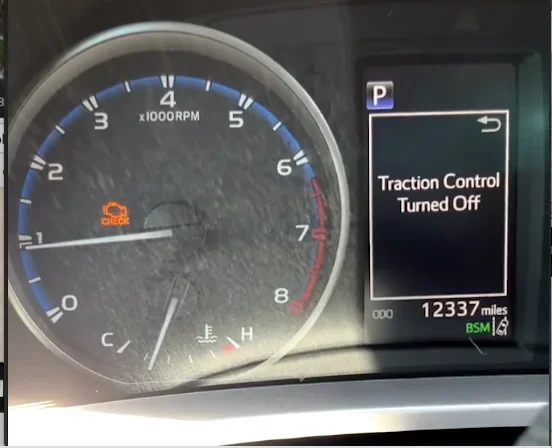
The TRAC OFF indicator light looks like a car with squiggly lines behind it. When this light stays on, it means TRAC is manually turned off or there is a system fault. If you did not turn it off yourself, it could signal a problem. Common causes include a faulty wheel speed sensor or a problem with the ABS system.
The TRAC Warning Light Flashing
If the TRAC light flashes while you are driving, the system is actively working. It is detecting wheel slip and intervening. This is normal behavior on slippery roads. However, if it flashes constantly on dry roads, something may be wrong. You should get the system checked by a mechanic.
The Check Engine Light Alongside TRAC
Sometimes the check engine light and TRAC light come on together. This often points to an issue with the engine or emissions system. A faulty oxygen sensor or mass airflow sensor can trigger both lights. Since TRAC relies on engine data, any engine problem can affect its performance.
TRAC Light Comes on After a Bump or Impact
If you hit a pothole or speed bump hard, the TRAC light may come on temporarily. This is usually caused by a disrupted wheel speed sensor reading. It often clears on its own after a few miles. But if it stays on, you should have it inspected.
TRAC Off vs. Other Safety Systems in Your Toyota
TRAC does not work alone. It is part of a larger safety ecosystem in your Toyota. Understanding how these systems relate helps you make better decisions.
TRAC vs. VSC (Vehicle Stability Control)
VSC is a broader system that includes TRAC. While TRAC focuses on wheel spin, VSC looks at the overall path of the vehicle. VSC uses steering input and yaw rate to detect if the car is sliding. If it detects a slide, it applies brakes to individual wheels and reduces engine power. Many Toyota models have a single button that controls both TRAC and VSC.
TRAC vs. ABS (Anti-lock Braking System)
ABS prevents your wheels from locking up during hard braking. TRAC prevents wheels from spinning during acceleration. They are complementary systems. Both use wheel speed sensors and the ABS modulator. When one system has a problem, it can affect the other. This is why a TRAC warning sometimes means the ABS system needs attention too.
TRAC vs. Electronic Brakeforce Distribution (EBD)
EBD distributes braking force between the front and rear wheels. It adjusts based on how much weight is on each axle. TRAC and EBD work together to keep the car stable. Neither system can fully replace the other. They are designed to function as a team.
TRAC vs. Hill Start Assist Control (HAC)
HAC prevents your car from rolling backward on a hill. It holds the brakes for a few seconds when you shift from brake to gas. TRAC does not perform this function. HAC is separate but also contributes to overall vehicle stability. Both systems are part of Toyota’s commitment to safety.
Expert Tips for Using TRAC Correctly
Here are some practical tips from experienced drivers and automotive experts. These will help you use TRAC wisely and stay safe on the road.
Tip 1: Keep TRAC On for Daily Driving
For 90 percent of driving situations, TRAC should stay on. It adds a layer of protection you may not even notice. On rainy days, gravel roads, or winding highways, TRAC works hard to keep you stable. Leaving it on is the safest default choice.
Tip 2: Know When to Turn It Off
Only turn TRAC off when you have a clear reason. Deep snow, mud, or being stuck are valid reasons. Turn it off, get through the tricky spot, and turn it back on right away. Do not drive long distances with TRAC off unless absolutely necessary.
Tip 3: Check Your Owner Manual
Every Toyota model has specific instructions for TRAC. The owner manual explains exactly how the system works on your vehicle. It also tells you where the TRAC button is located. Some models have the button near the steering column. Others place it on the center console. Refer to your manual for the exact location.
Tip 4: Do Not Ignore Warning Lights
If the TRAC light stays on, do not ignore it. It could be a simple fix like a dirty wheel speed sensor. Or it could be a more serious ABS issue. Either way, getting it checked early can prevent bigger problems. A small fix now saves you from costly repairs later.
Tip 5: Practice Safe Driving Habits
No safety system can replace good driving habits. Maintain a safe following distance. Slow down in bad weather. Avoid sudden acceleration or hard braking. Even with TRAC off, these habits keep you and others safe on the road.
Common Mistakes People Make With TRAC Off
Many drivers make avoidable mistakes when dealing with TRAC. Here are the most common ones and how to avoid them.
- Leaving TRAC Off After Recovery: A lot of drivers turn off TRAC to get unstuck and forget to turn it back on. Always double-check that TRAC is active before hitting the road.
- Turning Off TRAC on Highways: Driving with TRAC off on a highway is risky. High speeds combined with wet or uneven pavement can lead to serious accidents.
- Ignoring the TRAC Light: Some drivers treat the TRAC light as a minor annoyance. It can signal a real problem with your ABS or stability control system.
- Confusing TRAC Off with ABS Off: These are different systems. TRAC off only disables traction control. ABS may still be active. However, some Toyota models link both systems to one button.
- Turning TRAC Off on Icy Roads: This is one of the most dangerous mistakes. Icy roads need all the help they can get. Keep TRAC on and drive slowly and carefully.
Key Takeaways
- TRAC is a vital safety system: It prevents wheel spin and helps you maintain control on slippery surfaces.
- It is OK to turn TRAC off in specific situations: Deep snow, mud, and being stuck are valid reasons to disable it temporarily.
- Driving with TRAC off on wet or icy roads is dangerous: The system provides critical stability that you cannot replicate by driving alone.
- Always turn TRAC back on after use: Forgetting to reactivate it leaves you without an important safety feature.
- Warning lights mean pay attention: A persistent TRAC light could indicate a sensor issue or ABS problem that needs professional diagnosis.
- TRAC works with ABS and VSC: These systems work together to keep your Toyota stable and safe in all conditions.
- Daily driving should always have TRAC on: For normal road conditions, keeping TRAC active is the safest choice.
Frequently Asked Questions
Can I drive with TRAC off every day?
You should not drive with TRAC off every day. TRAC is a safety feature designed to help you maintain control in unexpected situations. Disabling it daily removes an important layer of protection. Only turn it off temporarily when you have a specific reason, like being stuck in snow or mud.
What does the TRAC off light mean on my Toyota?
The TRAC off light means that the traction control system has been manually disabled or there is a system fault. If you pressed the TRAC button, the light will turn on. If you did not press it, the light may indicate a sensor problem, ABS issue, or a fault in the stability control system. In that case, you should get your vehicle inspected.
Will driving with TRAC off damage my car?
Driving with TRAC off will not directly damage your car. However, it does increase the risk of wheel spin, loss of control, and accidents. Repeated aggressive driving with TRAC off can put extra stress on tires and drivetrain components. The real risk is to your safety, not the vehicle itself.
Should I turn TRAC off in the snow?
You should only turn TRAC off in the snow if your car is stuck and needs to rock back and forth to gain traction. On moving through snow, TRAC helps keep you stable. Turning it off while driving on snowy roads can make it harder to control the vehicle. Use TRAC off only as a short-term recovery tool.
Does TRAC off affect ABS?
In most Toyota models, TRAC off does not disable ABS. They are separate systems. However, some models link both to the same button. If your model does this, pressing the TRAC off button may also disable a portion of the ABS stability functions. Check your owner manual to understand how these systems interact in your specific vehicle.
Can a bad wheel speed sensor cause the TRAC light to come on?
Yes, a faulty wheel speed sensor is one of the most common reasons the TRAC light comes on. These sensors feed data to both TRAC and ABS. If one sensor fails, the system may disable traction control and trigger the warning light. Replacing a wheel speed sensor is usually a straightforward and affordable repair.
Conclusion
So, is it OK to drive with TRAC off? The answer comes down to context. In the right situation, like deep snow or mud, turning TRAC off temporarily is perfectly fine. It can help you get unstuck or navigate tough terrain. But for everyday driving, keeping TRAC on is the safest choice. The system works silently to protect you from wheel spin and loss of control.
Understanding your vehicle’s safety features gives you confidence behind the wheel. TRAC is one of those features that you should respect and use wisely. When in doubt, leave it on. Your Toyota was engineered with TRAC for a reason. It works alongside ABS, VSC, and other systems to keep you safe on every road.
Always pay attention to warning lights on your dashboard. They are your car’s way of communicating with you. If the TRAC light stays on, do not delay getting it checked. A quick visit to your mechanic can save you from bigger problems down the road. Stay safe, drive smart, and let TRAC do its job when you need it most.