Can the Nissan Ariya Use a Tesla Charger at Home Today
Yes, the Nissan Ariya can use a Tesla charger at home with the right adapter. You will need a Tesla to CCS adapter or a J1772 adapter depending on your Tesla charger type. This setup lets you charge your Ariya using Tesla charging infrastructure and enjoy the convenience of a widely available network. This guide covers Tesla adapter compatibility, setup steps, charging speeds, and practical tips for a smooth experience.
If you own a Nissan Ariya and have been wondering whether you can use a Tesla charger at home, you are not alone. The electric vehicle charging world can feel confusing, especially when different brands use different connectors and networks. The good news is that can the Nissan Ariya use a Tesla charger is a question with a clear and practical answer. With the right adapter and a little know-how, you can absolutely charge your Ariya using Tesla equipment in the comfort of your own home.
The Nissan Ariya is a compelling electric SUV that offers impressive Nissan Ariya range, modern technology, and a sleek design. But one question that comes up often among potential and current owners is about charging flexibility. Can you use the growing Tesla charging network or your own Tesla Wall Connector to power up your Ariya? The answer depends on a few factors, but the short version is yes, it is possible. This article breaks down everything you need to know about Tesla adapter compatibility, setup requirements, charging speeds, and practical tips to make it all work smoothly.
Whether you are a first-time EV buyer exploring your options or an Ariya owner looking for a simpler charging at home solution, this guide has you covered. We will walk through the technical details in plain language, share real-world examples, and give you actionable advice you can use right away. By the end, you will have a clear picture of how to use a Tesla charger with your Nissan Ariya and feel confident about your setup.
Key Takeaways
- Yes, It Works: The Nissan Ariya can charge on a Tesla charger at home using the correct adapter.
- Adapter Is Key: You need a Tesla to CCS adapter or J1772 adapter to connect the Ariya to a Tesla charger.
- Home Charging Made Easy: Setting up a Tesla Wall Connector with the right adapter gives you a reliable home charging station.
- Speed Varies: Charging speed depends on the charger type, adapter, and your Ariya battery capacity.
- Check Compatibility: Not all Tesla chargers work the same way with the Ariya. Know your setup before buying.
- Avoid Common Mistakes: Using the wrong adapter or skipping setup steps can cause slow charging or errors.
- Worth the Investment: For Ariya owners who already have Tesla charging equipment, using it is a smart and cost-effective choice.
📑 Table of Contents
Understanding the Nissan Ariya and Its Charging Setup
Before diving into Tesla charger compatibility, it helps to understand how the Nissan Ariya charges in the first place. The Ariya uses a CCS charging port, which is the standard connector for most electric vehicles sold in North America and Europe. This port supports both Level 1 and Level 2 electric vehicle charging at home, as well as DC fast charging at public stations.
The Ariya’s Charging Port and Power Levels
The Ariya comes with a CHAdeMO port and a CCS port on the front left side of the vehicle. The CCS port is what you will use for most home and public fast charging. Here is a quick look at the power levels the Ariya supports:
- Level 1 Charging: Uses a standard 120V household outlet. Very slow, adding about 3 to 5 miles of range per hour.
- Level 2 Charging: Uses a 240V home charging station. This is the most common setup for daily home charging and adds about 25 to 30 miles of range per hour.
- DC Fast Charging: Uses a 400V or 800V public charging station. Can add up to 150 miles of range in about 30 minutes, depending on conditions.
The Ariya’s battery capacity ranges from about 63 kWh to 87 kWh depending on the trim level. A larger battery takes longer to charge but also gives you more driving range. Understanding these basics makes it easier to see how a Tesla charger fits into the picture.
How Fast Can the Ariya Charge?
The Ariya supports up to 130 kW of DC fast charging on the CCS port. For home charging, the maximum AC power intake is around 11 kW on Level 2. This means that a Level 2 charger can fully charge an Ariya from empty to full in roughly 7 to 8 hours. This is the sweet spot for overnight charging at home and is exactly the kind of speed a Tesla Wall Connector can deliver.
Can the Nissan Ariya Use a Tesla Charger at Home?
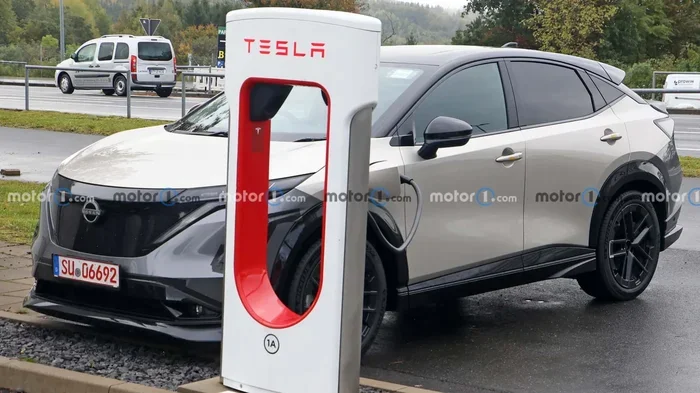
Now for the big question: can the Nissan Ariya use a Tesla charger at home? The answer is yes, but with one important caveat. Tesla chargers use a proprietary connector in North America that is different from the CCS connector on the Ariya. However, Tesla has been expanding its adapter support, and there are ways to bridge this gap.
Tesla Wall Connector and the Ariya
The Tesla Wall Connector is one of the most popular home charging solutions. It delivers up to 48 amps on a 240V circuit, which translates to about 11.5 kW of power. This is well within the Ariya’s Level 2 charging capability. However, the Tesla Wall Connector uses a Tesla-specific connector, so you cannot plug the Ariya directly into it.
To make this work, you need a Tesla to CCS adapter or a J1772 adapter that fits the Tesla Wall Connector output. Tesla has released adapters over the years, and the availability of a compatible adapter is the key to making this setup function. Once you have the right adapter, the connection is straightforward and safe.
Tesla Destination Chargers and the Ariya
Tesla Destination Chargers are found at hotels, restaurants, and shopping centers. These chargers typically use a J1772 connector, which is a universal standard. The good news is that the Nissan Ariya can use a J1772 connector directly with its CCS port using a simple J1772 to CCS adapter. So if you are at a location with a Tesla Destination Charger, you can likely charge your Ariya there with the right adapter on hand.
Tesla Supercharger Compatibility
Tesla Superchargers use a dedicated connector that is not directly compatible with the Ariya. While Tesla has opened its Supercharger network to other EV brands in some regions, the Ariya would still need a specific adapter to use these stations. For home charging purposes, the Tesla Wall Connector and Destination Chargers are the most relevant options for Ariya owners.
What You Need to Make It Work at Home
Setting up a Tesla charger for your Nissan Ariya at home requires a few pieces of equipment and some basic knowledge. Here is everything you need to know to get started.
The Right Adapter for Your Ariya
The most critical piece of the puzzle is the adapter. You need a Tesla adapter compatibility solution that bridges the gap between the Tesla charger output and the Ariya’s CCS port. Here are the main options:
- Tesla to CCS Adapter: This adapter connects directly to the Tesla Wall Connector and allows the Ariya’s CCS plug to attach. Make sure the adapter supports the amperage your Wall Connector outputs.
- J1772 to CCS Adapter: If your Tesla charger has a J1772 output, this adapter lets the Ariya connect directly. This is often the simpler and more widely available option.
- Tesla Mobile Connector with Adapter: The Tesla Mobile Connector can also be used at home with the right adapter, though it charges slower than the Wall Connector.
Setting Up Your Home Charging Station
Once you have the correct adapter, setting up your home charging station is fairly straightforward. Here are the steps:
- Install the Tesla Wall Connector on a dedicated 240V circuit. Hire a licensed electrician if you are not comfortable with electrical work.
- Connect the appropriate adapter to the Wall Connector output.
- Plug the Ariya’s CCS connector into the adapter.
- Start the charging session through the Ariya’s dashboard or the Tesla app (if applicable).
- Monitor the first few sessions to make sure everything is working correctly and the charging speed is as expected.
Quick Tips for a Smooth Setup
- Always check the amperage rating of your adapter. Using an adapter rated for lower amperage than your charger outputs can limit charging speed or cause overheating.
- Keep your adapter connections clean and dry. Moisture can cause corrosion over time and affect performance.
- Store your adapter in a cool, dry place when not in use to extend its lifespan.
- Update your Ariya’s software regularly. Nissan occasionally releases updates that improve charging performance and compatibility.
- Test your setup with a short charging session before relying on it for a full overnight charge.
Common Mistakes to Avoid
Many people run into issues when setting up a Tesla charger for the Ariya. Here are the most common mistakes and how to avoid them:
- Using the wrong adapter: Not all adapters are created equal. Make sure the adapter supports both the connector type and the power level of your Tesla charger.
- Ignoring amperage limits: If your adapter is rated for 32 amps but your Wall Connector outputs 48 amps, you will either get an error or be limited to 32 amps. Always match the ratings.
- Skipping the electrical inspection: Having an electrician verify your home’s electrical panel and wiring before installation prevents safety hazards and ensures optimal performance.
- Forcing a connection: If a connector does not fit easily, stop and check that you have the correct adapter. Forcing it can damage the port or the adapter.
Charging Speed and Real-World Performance
One of the most common questions Ariya owners have is how fast they can charge using a Tesla charger. The answer depends on several factors, including the charger type, the adapter, and your specific Ariya model.
How Fast Can You Charge with a Tesla Charger?
When using a Tesla Wall Connector with the correct adapter, the Ariya will charge at Level 2 speeds. This means you can expect around 25 to 30 miles of range per hour of charging. A full charge from empty to full on an 87 kWh battery will take roughly 7 to 8 hours. On a 63 kWh battery, the time drops to about 5 to 6 hours.
For comparison, using the Mobile Connector (which plugs into a standard 120V outlet) will give you only about 3 to 5 miles of range per hour. This is fine for overnight top-ups but not ideal for daily use if you drive a lot.
Comparing Charging Speeds
Here is a quick comparison of different charging options for the Nissan Ariya:
| Charging Method | Power Output | Range Added Per Hour | Full Charge Time (87 kWh) |
|---|---|---|---|
| Level 1 (Standard Outlet) | 1.4 kW | 3 to 5 miles | 40+ hours |
| Tesla Wall Connector with Adapter | Up to 11.5 kW | 25 to 30 miles | 7 to 8 hours |
| J1772 Level 2 Charger | Up to 11 kW | 25 to 30 miles | 7 to 8 hours |
| DC Fast Charging (CCS) | Up to 130 kW | 150+ miles (30 min) | 20 to 30 minutes (10% to 80%) |
As you can see, a Tesla Wall Connector with the right adapter delivers the same charging speed as a standard Level 2 charger. This is more than enough for most daily driving needs and makes overnight charging at home very convenient.
Quick Tips for Faster Charging
- Pre-condition your Ariya’s battery before charging, especially in cold weather. This warms up the battery and improves charging efficiency.
- Charge during off-peak electricity hours to save on energy costs and reduce strain on your home’s electrical system.
- Keep your Ariya plugged in every night rather than waiting for the battery to get very low. Regular top-ups help maintain battery health.
- Use the Ariya’s built-in charging timer to schedule charging during cheaper rate periods if your utility offers time-of-use pricing.
- Make sure your adapter connections are tight and secure. Loose connections can reduce charging speed and generate heat.
Pros and Cons of Using a Tesla Charger with the Nissan Ariya
Like any charging setup, using a Tesla charger with the Ariya has its advantages and disadvantages. Let us break them down so you can make an informed decision.
Advantages of Going This Route
- Convenience: If you already own a Tesla charger or have access to one, adding an adapter is a simple and cost-effective way to charge your Ariya at home.
- Reliable Build Quality: Tesla Wall Connectors are well-built and durable. They are designed for daily use and can handle the power demands of the Ariya without issues.
- Wide Availability: Tesla chargers and accessories are widely available online and in stores, making it easy to find what you need.
- Future-Proofing: Tesla continues to expand its charging network and develop new adapters. Investing in Tesla charging equipment now means you stay compatible with future updates.
- Smart Features: The Tesla Wall Connector connects to Wi-Fi and can be monitored and controlled through the Tesla app. You can track charging sessions, set schedules, and receive notifications.
Things to Watch Out For
- Adapter Cost and Availability: Not all adapters are easy to find, and some third-party options may not be as reliable. Always buy from reputable sellers and check compatibility before purchasing.
- Charging Speed Limitations: While the Tesla Wall Connector works well, it will not give you DC fast charging speeds. For the fastest possible charging, you will still need a public CCS fast charger.
- Warranty Considerations: Using third-party adapters or non-Tesla chargers may affect your Ariya’s warranty in some cases. Check with your dealer before setting up a non-standard charging solution.
- Setup Complexity: While the setup is not overly complicated, it does require the right adapter and a basic understanding of your charging equipment. If you are not tech-savvy, consider having a professional handle the installation.
Expert Insights
According to EV charging experts, using a Tesla Wall Connector with a compatible adapter is one of the most reliable home charging setups available. The Tesla Wall Connector delivers consistent power output and has built-in safety features like ground fault protection and temperature monitoring. For Ariya owners, this means a safe and dependable home charging station that works seamlessly with the vehicle’s charging system. Experts also recommend always keeping a spare adapter on hand, especially if you travel frequently and may need to charge at different locations.
When it comes to electric vehicle charging infrastructure, having options is always better than having just one. Using a Tesla charger for your Ariya gives you an additional pathway to keep your vehicle powered, which is especially valuable if your primary charging option is temporarily unavailable.
Final Thoughts and Recommendations
So, can the Nissan Ariya use a Tesla charger? Absolutely. With the right adapter and a Tesla Wall Connector, you can set up a reliable and efficient home charging station for your Ariya. The process is straightforward, the charging speeds are more than adequate for daily use, and the setup gives you the flexibility to charge your electric SUV whenever you need to.
The key to success is getting the right adapter, matching the power ratings, and following proper setup procedures. Avoid the common mistakes outlined in this guide, and you will have a smooth and hassle-free charging at home experience. Whether you are new to the Nissan Ariya or have been driving one for a while, using a Tesla charger is a practical and smart choice that adds convenience to your daily routine.
Take the time to research your specific setup, invest in quality equipment, and enjoy the peace of mind that comes with a fully charged Ariya every morning. The world of electric vehicle charging is more connected than ever, and the ability to use different networks and chargers is a huge advantage for EV owners. Embrace the flexibility, and happy charging.
Frequently Asked Questions
Can I charge my Nissan Ariya at a Tesla Supercharger?
Currently, Tesla Superchargers use a proprietary connector that is not directly compatible with the Nissan Ariya. While Tesla is opening its Supercharger network to other brands in some regions, you would need a specific adapter to use these stations with the Ariya. For now, home charging with a Tesla Wall Connector and adapter is the most practical option.
What adapter do I need to connect my Ariya to a Tesla Wall Connector?
You need a Tesla to CCS adapter or a J1772 to CCS adapter, depending on the output of your Tesla Wall Connector. Make sure the adapter supports the amperage rating of your charger to ensure safe and optimal charging speeds. Always purchase adapters from reputable sellers to ensure quality and reliability.
Is it safe to use a Tesla charger with the Nissan Ariya?
Yes, it is safe as long as you use a compatible adapter and follow proper setup procedures. Tesla Wall Connectors include built-in safety features like ground fault protection and temperature monitoring. Just make sure your adapter matches the power ratings of your charger and your Ariya’s charging system.
How long does it take to charge a Nissan Ariya with a Tesla Wall Connector?
With a Tesla Wall Connector and the correct adapter, the Ariya charges at Level 2 speeds. This means roughly 25 to 30 miles of range per hour. A full charge from empty to full on an 87 kWh battery takes about 7 to 8 hours, and on a 63 kWh battery it takes about 5 to 6 hours.
Will using a Tesla charger void my Nissan Ariya warranty?
Using a Tesla Wall Connector with a compatible adapter should not void your warranty. However, using uncertified third-party adapters or improper setups could potentially cause issues. It is always best to check with your Nissan dealer before setting up any non-standard charging equipment to understand your warranty coverage.
Can I use a Tesla Mobile Connector to charge my Ariya at home?
Yes, you can use a Tesla Mobile Connector with the right adapter to charge your Ariya at home. However, the Mobile Connector charges much slower than the Wall Connector, typically adding only 3 to 5 miles of range per hour. It works best as a backup or occasional charging option rather than a primary home charging solution.