What Are the Basic Controls of a Forklift Explained
Understanding the basic controls of a forklift is essential for safe and efficient operation in any warehouse or industrial setting. This guide breaks down every major control system, from the steering wheel and pedals to the hydraulic lever and safety brakes. Whether you are new to forklift operation or need a refresher, you will find clear, practical explanations that make learning easy and approachable.
If you have ever walked through a warehouse and watched a forklift glide by, you might have wondered how the driver actually controls the machine. Forklifts are powerful pieces of industrial equipment, and knowing how to operate them safely is no small task. The basic controls of a forklift might look simple at first glance, but each one plays a vital role in keeping the operator and those nearby safe.
Whether you are brand new to the world of lift trucks or you have been driving for years and want to sharpen your skills, this guide covers everything you need to know. We will walk through every major control system step by step. You will learn about the steering mechanism, the pedal setup, the hydraulic lever, and all the safety features that make forklift operation possible.
The goal here is simple. Give you the knowledge and confidence to understand how a forklift works from the ground up. No fluff, no filler, just clear and practical information you can use right away. So let us dive in and explore the world of forklift controls together.
Key Takeaways
- Forklift controls include steering, pedals, levers, and safety devices that work together to manage movement and lifting
- The dashboard and gauges give operators real-time information about the lift truck’s performance
- Steering a forklift is very different from driving a car because the rear wheels do the turning
- The hydraulic lever controls lifting and lowering of the forks and carriage
- Safety controls like the parking brake, horn, and emergency stop are critical for preventing accidents
- Proper training and practice are essential before operating any forklift in a real work environment
- Regular inspections and maintenance keep forklift controls functioning properly and safely
📑 Table of Contents
Understanding the Forklift Control Panel
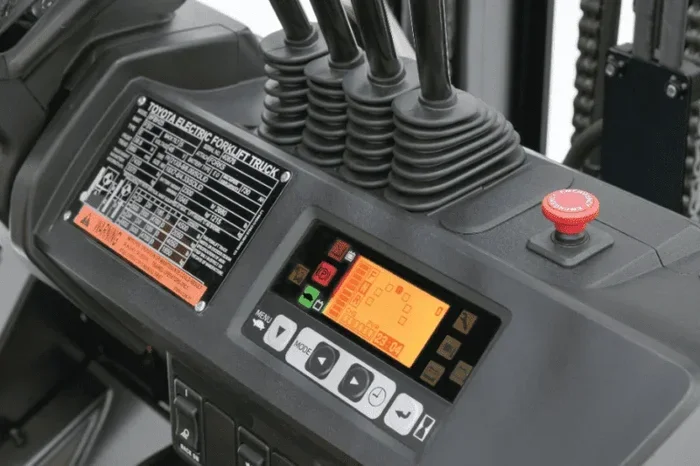
Before you touch any lever or pedal, it helps to understand what sits right in front of you. The forklift dashboard is your command center. It houses all the gauges, switches, and indicators that tell you what is happening with the machine at any given moment. Getting familiar with this panel is the first step toward becoming a confident operator.
What’s on the Forklift Dashboard
The forklift dashboard layout can vary slightly depending on the model and manufacturer. However, most forklifts share a similar arrangement of instruments and controls. You will typically find the ignition switch, gear shift, and a cluster of gauges mounted on or near the steering column. Some models also have a digital display screen that shows real-time data.
The ignition switch is where you start the engine. Just like a car, you turn the key or press a button to power up the forklift. The gear shift allows you to select forward or reverse gear. Understanding the gear shift is crucial because forklifts operate differently than standard vehicles. The gear placement and shift pattern may feel unfamiliar at first, but it becomes second nature with practice.
Display Gauges and Warning Lights
The gauges on your forklift dashboard give you important information at a glance. Most forklifts include a speedometer, tachometer, fuel or battery gauge, and oil pressure indicator. Each gauge serves a specific purpose. The speedometer tells you how fast you are moving. The tachometer shows the engine’s revolutions per minute. The fuel gauge lets you know how much power remains.
Warning lights are equally important. These small indicators on the forklift dashboard alert you to potential problems. For example, a red oil pressure light means the engine oil is too low. A yellow battery light signals a charging issue. Never ignore these warnings. They exist to protect you and the equipment. If a light comes on during operation, stop safely and investigate the issue before continuing.
Quick Tip: Before every shift, do a quick visual scan of all the gauges and warning lights. This simple habit can catch problems early and prevent costly breakdowns or safety incidents.
Steering and Movement Controls
Now let us talk about how a forklift actually moves. The steering and movement controls are what allow you to navigate the lift truck through tight aisles and open loading docks. Understanding these controls is fundamental to safe forklift operation.
How the Steering Wheel Works
The forklift steering wheel sits in front of the operator, much like a car. You grip it, turn it, and the forklift responds. However, there is one major difference. Forklifts use rear-wheel steering, not front-wheel steering like a car. This means the back end of the lift truck swings wide when you turn.
This is something many new operators do not expect. When you turn the steering wheel to the right, the rear of the forklift swings to the left. It feels counterintuitive at first. This is why forklift training emphasizes slow, deliberate turns. Always reduce your speed before making a turn. The counterweight at the rear of the forklift helps balance the load, but it also means the machine can tip if you turn too fast.
Here is a simple way to remember it. Treat the forklift like a pendulum. The heavy rear end swings wide with every turn. Give yourself extra space when navigating corners and intersections. This small awareness goes a long way toward preventing tip-over accidents.
The Pedal System: Accelerator, Brake, and Inching Pedal
The forklift pedals are another set of controls you need to master. Most forklifts have three pedals arranged on the floor. From left to right, you will typically find the inching pedal, the brake pedal, and the accelerator pedal.
The accelerator pedal works just like a car pedal. Press down to speed up. Release it to slow down. The brake pedal stops the forklift. Both of these should feel familiar if you have driven a car before.
The inching pedal is unique to forklifts. It is the leftmost pedal and serves a special purpose. When you press the inching pedal, it disengages the transmission. This allows you to stop the engine from moving the forklift while still giving it power. You use the inching pedal when you need to lift or lower the forks while the forklift is stationary. It gives you precise control over the hydraulic functions without the machine rolling forward or backward.
Quick Tip: Practice pressing the inching pedal gently. You do not need to slam it down. A light, controlled press gives you the smoothest operation and the best control over your lift truck.
Moving Forward and in Reverse
Moving a forklift forward or in reverse is straightforward once you understand the gear system. Use the gear shift to select forward or reverse. Then release the parking brake and gently press the accelerator.
Always look in the direction you are traveling. When moving forward, face the front of the forklift. When moving in reverse, turn your body and look back over your shoulder. Some forklifts have rear-view mirrors or cameras to help with visibility, but they are not a substitute for turning around and checking your surroundings.
Keep your speed low, especially in areas with pedestrian traffic. Warehouses and loading docks are busy places. People walk between forklifts and stacked pallets every day. A slow and steady pace gives you more time to react to obstacles, people, or unexpected changes in your path.
Lifting and Lowering Controls
This is where forklifts really shine. The lifting mechanism is what sets them apart from regular trucks and vehicles. Understanding the lifting controls is essential for any operator who needs to move heavy loads safely.
The Hydraulic Lever and Mast Controls
The hydraulic lever is the primary control for raising and lowering the forks. This lever is usually located to the right of the steering column. It connects to the forklift’s hydraulic system, which uses pressurized fluid to move the mast up and down.
When you push the hydraulic lever forward, the forks go down. When you pull it back toward you, the forks rise. It is a simple push-and-pull motion, but the control requires finesse. Move the lever smoothly and avoid jerky movements. Abrupt actions can cause the load to shift or slide off the forks.
The mast is the vertical assembly that supports the forks and carriage. It rises and falls based on the hydraulic pressure you apply. Different forklifts have different mast types. Some have a single-stage mast that raises and lowers in one movement. Others have a two-stage or three-stage mast that provides greater lift heights. Regardless of the type, the control method remains the same. Smooth, deliberate movements keep the load stable and the operation safe.
Using the Tilt Lever
Next to the hydraulic lever, you will usually find the tilt lever. This control allows you to tilt the mast and forks backward or forward. Tilt is important for securing loads during transport. When you tilt the forks backward slightly, the load rests more firmly against the carriage and is less likely to slide off.
Use the tilt lever to adjust the angle of the forks before and during transport. A slight backward tilt is standard for most loads. However, be careful not to tilt too far backward, especially when the forks are elevated. Tilting too far can shift the center of gravity and increase the risk of a tip-over. This is one of the most important forklift safety rules to remember.
Carriage and Fork Operation
The carriage is the metal platform that slides up and down the mast rails. The forks are attached to the carriage and are what actually slide under the load. Understanding how the carriage works helps you operate the forklift more efficiently.
You can adjust the fork width on some forklifts. This is done using a side-shift mechanism that moves the carriage left or right. This feature is incredibly useful when you need to align the forks precisely with a pallet or load. It saves time and reduces the risk of damaging the load or the racking system.
Always check the load capacity before lifting. Every forklift has a rated maximum capacity, and this number is displayed on the data plate. Exceeding the load capacity is one of the leading causes of forklift accidents. If the load is too heavy, do not attempt to lift it. Find a forklift with a higher capacity or split the load into smaller loads.
Safety Controls and Braking Systems
Safety controls are not optional extras. They are essential components of every forklift. These systems protect the operator, nearby workers, and the equipment itself. Let us go through the most important safety controls you need to know.
The Parking Brake and Emergency Stop
The parking brake is a critical safety feature. When you leave the forklift, even for a moment, engage the parking brake. This prevents the lift truck from rolling away, especially on slopes or uneven surfaces. Most forklifts have a lever or pedal near the operator’s seat that activates the parking brake. Pull it up or press it down, and the brake engages.
Some forklifts also have an emergency stop button. This is a large, easily accessible button that immediately cuts power to the engine and stops all movement. You should know where the emergency stop is located before you start the forklift. In an emergency, you do not want to be fumbling around looking for it.
Quick Tip: Make it a habit to test the parking brake and emergency stop during your pre-shift inspection. These safety devices need to work every single time. A faulty parking brake is a serious hazard that should never be ignored.
Horn, Lights, and Other Warning Devices
Forklifts come equipped with several warning devices to alert people around you. The horn is the most basic and important one. A quick tap on the horn warns pedestrians and other operators that you are nearby. Use the horn at intersections, blind corners, and when approaching doorways. It is a simple courtesy that goes a long way toward preventing accidents.
Lights and beacons are also standard on most forklifts. Blue spotlights project a bright circle on the floor in front of or behind the forklift. Red zone lights warn pedestrians to stay back. Flashing beacons on the top of the cab make the forklift highly visible in busy warehouses. Use all of these devices, especially in areas with limited visibility or high foot traffic.
Many modern forklifts also have backup alarms that beep when the machine is in reverse. Some even have proximity sensors that detect obstacles and alert the operator. These technological advances have made forklift operation significantly safer. But they work best when the operator uses them consistently and correctly.
Tips for New Forklift Operators
If you are new to forklift operation, the controls might feel overwhelming at first. That is completely normal. Every experienced operator started exactly where you are now. Here are some practical tips to help you get started on the right foot.
Start with Proper Training
Forklift training is not just a formality. It is the foundation of safe operation. Before you ever start a forklift, complete a certified forklift training program. These programs cover all the major controls, safety procedures, and operating best practices. They also include hands-on practice under the supervision of a qualified instructor.
In most regions, forklift certification is legally required. Employers must ensure their operators are properly trained and certified. This is not just a legal obligation. It is a commitment to workplace safety. A well-trained operator is far less likely to cause an accident or damage equipment.
Practice in Safe, Open Areas First
When you first start operating a forklift, choose a safe, open area with no pedestrians or obstacles. Practice moving forward and in reverse, turning, and stopping. Get a feel for the controls and how the forklift responds to your inputs.
Focus on smooth movements. Avoid sudden acceleration, sharp turns, and hard braking. The goal is to develop a feel for the machine. Over time, you will develop the muscle memory and confidence to handle more complex tasks. But that only comes with practice and patience.
Quick Tip: Start with an empty forklift. Lifting adds another layer of complexity. Master the movement controls first, then gradually introduce lifting and tilting as your confidence grows.
Read the Operating Manual
Every forklift comes with an operating manual. It might seem boring, but it is one of the most valuable resources you have. The manual explains the specific controls, capacity limits, and maintenance requirements for your particular model. Read it thoroughly before you start operating the forklift.
If you ever encounter a control or feature you do not understand, refer back to the manual or ask a supervisor. There is no such thing as a silly question when it comes to forklift safety. Understanding your equipment is the best way to protect yourself and those around you.
Common Mistakes to Avoid
Even experienced operators can make mistakes. But knowing what goes wrong helps you avoid the same pitfalls. Here are some common errors to watch out for.
Overloading the Lift Truck
Overloading is one of the most dangerous things you can do with a forklift. Every forklift has a rated load capacity, and exceeding it can cause the machine to tip forward. The counterweight at the rear is designed to balance a specific maximum load. When you exceed that load, the balance is thrown off and the forklift can become unstable.
Always check the weight of the load before lifting. If you are unsure, use a scale or consult the shipping documentation. It is better to be safe and make multiple trips than to risk a tip-over accident.
Skipping Daily Inspections
Daily inspections are a non-negotiable part of forklift operation. Before each shift, walk around the forklift and check for visible damage, leaks, or worn components. Test the brakes, steering, horn, and all safety controls. If anything is not working properly, report it immediately and do not operate the forklift until it is repaired.
Skipping inspections is a shortcut that can lead to serious consequences. A forklift with faulty brakes or a malfunctioning hydraulic system is a hazard to everyone in the workplace. Make inspections a habit, not an afterthought.
Ignoring the Load Center
The load center is the distance from the face of the forks to the center of gravity of the load. When you place a load off-center or unevenly on the forks, the effective load capacity decreases. This means a forklift that could normally handle a certain weight may not be able to handle it if the load is unbalanced.
Always center the load on the forks as much as possible. Make sure the load is stable and secure before moving. If the load is tall or top-heavy, tilt the mast backward slightly to keep it stable during transport. These small adjustments make a big difference in safety.
Final Thoughts on Forklift Controls
The basic controls of a forklift are not complicated. They include the steering wheel, pedals, hydraulic lever, tilt lever, and various safety devices. Each one serves a specific purpose, and understanding how they all work together is the key to safe and efficient forklift operation.
Whether you are operating a counterweight forklift, a reach truck, or a pallet jack, the principles remain the same. Smooth movements, constant awareness, and respect for the equipment go a long way. The forklift is a powerful tool, and with the right knowledge and training, you can use it safely and effectively every single day.
Remember, forklift safety starts with you. Take the time to learn the controls, practice regularly, and never skip your inspections. The more you know about your forklift, the more confident and capable you will become. Safe operations benefit everyone in the workplace, from the operator to the people walking nearby.
So the next time you sit in the operator’s seat, take a moment to appreciate the engineering and design that goes into every forklift control. Each lever, pedal, and gauge is there for a reason. Respect the equipment, follow the safety protocols, and you will have a long and successful career as a forklift operator.
Frequently Asked Questions
What are the three main pedals on a forklift?
The three main pedals are the inching pedal on the left, the brake pedal in the middle, and the accelerator pedal on the right. The inching pedal disengages the transmission so you can lift or lower loads while the forklift stays stationary. The brake stops the forklift, and the accelerator controls your speed.
How do you steer a forklift differently from a car?
Forklifts use rear-wheel steering, which means the back end swings wide when you turn. This is the opposite of a car, where the front wheels steer. Always slow down before turning and give yourself extra space. This difference is one of the most important things new operators need to understand.
What is the purpose of the hydraulic lever on a forklift?
The hydraulic lever controls the raising and lowering of the forks. When you push the lever forward, the forks go down. When you pull it back, the forks rise. It connects to the forklift’s hydraulic system and requires smooth, controlled movements to keep the load stable.
Why is forklift training important for operating basic controls?
Forklift training teaches you how to safely operate all the controls, from steering and pedals to lifting and safety systems. Proper training reduces the risk of accidents, equipment damage, and injuries. In most regions, forklift certification is legally required before you can operate a lift truck in a workplace.
What should you check during a pre-shift forklift inspection?
During a pre-shift inspection, check the brakes, steering, horn, lights, hydraulic system, and all warning lights on the forklift dashboard. Look for leaks, damage, or worn parts. Make sure the parking brake and emergency stop work properly. Report any issues before operating the forklift.
Can you modify the forklift controls for better ergonomics?
Some forklifts offer adjustable seats, tilt-adjustable steering columns, and customizable control layouts. These ergonomic features can reduce operator fatigue and improve comfort during long shifts. However, any modifications should be approved by the manufacturer or a qualified technician to ensure they do not affect safety or functionality.
=== CONCLUSION ===
The basic controls of a forklift are the foundation of safe and efficient material handling. From the steering wheel and pedals to the hydraulic lever and safety brakes, each control plays a vital role in your daily operations. Understanding how these systems work gives you the confidence to operate a forklift responsibly and effectively.
Take the time to study your forklift controls, practice regularly, and never skip your safety inspections. The more you know, the safer you will be. Forklift operation is a skill that improves with experience, and every shift is an opportunity to get better at what you do.
Remember, the goal is not just to move loads from point A to point B. The goal is to do it safely, efficiently, and with care for yourself and everyone around you. Master the basic controls, respect the equipment, and you will thrive in any warehouse or industrial environment.