How Do You Avoid High Beams When Driving At Night Time
Knowing how do you avoid high beams is one of the most important night driving skills you can learn. High beams help you see farther, but they blind oncoming drivers and cause dangerous glare. This guide covers simple techniques, smart technology, and practical habits that keep you and everyone else safe on dark roads.
Driving at night can feel peaceful. The roads are quieter. The stars are out. But there is a real challenge that every driver faces. How do you avoid high beams and still see the road clearly? This question matters more than most people think. Blinding other drivers is not just rude. It is dangerous. A sudden burst of bright light can cause temporary blindness. That split-second flash can lead to serious accidents. Learning to manage your headlights properly keeps everyone safer.
Night driving requires different skills than daytime driving. Your depth perception changes. Colors look different. And your ability to judge distances shrinks. High beam headlights are designed to help you see farther down the road. But they can also cause serious problems. The key is knowing when to use them and when to switch them off. This guide walks you through everything you need to know. You will learn practical tips, common mistakes, and modern solutions that make night driving easier.
Key Takeaways
- Switch to low beams early: Always dim your lights within 500 feet of oncoming traffic and 300 feet behind vehicles.
- Use automatic high beam systems: Modern cars have smart headlights that switch between high and low beams automatically.
- Keep headlights clean and aligned: Dirty or misaligned lights reduce visibility and cause unnecessary glare for others.
- Adjust your rearview mirror: Use the night setting to reduce glare from vehicles behind you.
- Practice the 3-second rule: Maintain safe following distance at night to compensate for reduced visibility.
- Know your dashboard indicators: The high beam warning light helps you track whether your lights are on correctly.
- Take breaks to fight eye fatigue: Resting your eyes reduces night blindness and improves your ability to judge road conditions.
📑 Table of Contents
- Understanding High Beams and Why They Matter
- Common Situations Where High Beams Become a Problem
- How to Avoid Using High Beams Unnecessarily
- Modern Technology That Helps You Avoid High Beams
- What to Do When Someone Else Uses High Beams on You
- Tips for Safe Night Driving Without High Beams
- Common Mistakes Drivers Make With High Beams
- Key Takeaways
- Conclusion
Understanding High Beams and Why They Matter
Before you can avoid high beams, you need to understand what they do. High beam headlights point straight ahead and throw light far down the road. They shine brighter than low beams. Most cars produce about 1,000 lumens on low beam and up to 1,500 lumens on high beam. That extra brightness helps you spot obstacles, animals, or debris earlier.
But here is the problem. That same brightness blinds other drivers. When light hits another person’s eyes, it takes time for their vision to recover. Studies show that it can take up to three seconds for eyes to adjust after a bright flash. At 60 miles per hour, your car travels 88 feet in just one second. That means you are driving blind for over 260 feet after being flashed. That is a terrifying thought.
There are two types of headlight systems most cars use today. The first is manual headlights. You flip a switch or turn a dial to change between low and high beams. The second is automatic headlights. These use sensors to detect oncoming traffic and switch beams for you. Both systems have their place. But neither works perfectly without driver input.
The Science Behind Headlight Glare
Glare happens when bright light enters your eye and overwhelms the retina. The pupil cannot constrict fast enough to reduce the light intake. This is especially true at night when your pupils are already wide open. Night blindness makes this problem worse. Some people struggle more with glare than others. Age plays a big role. Older drivers often experience more difficulty recovering from bright flashes.
Another factor is headlight alignment. Misaligned headlights aim too high or too wide. This increases glare for other drivers even when you are on low beam. Regular checks of your headlight aim can prevent this issue. A simple adjustment can make a huge difference for everyone on the road.
Low Beam vs High Beam: What Is the Difference
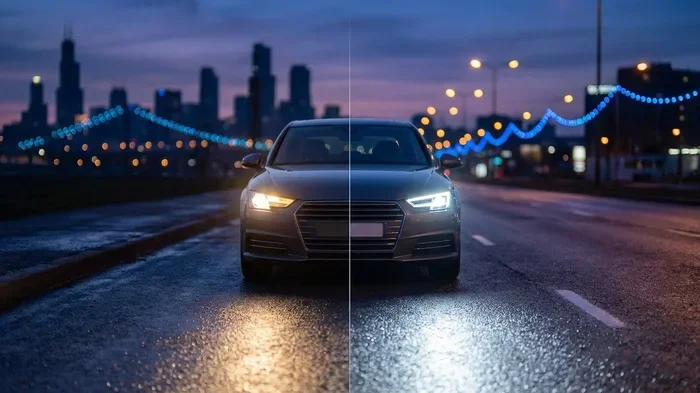
Understanding the difference helps you make better decisions. Low beam headlights aim downward toward the road. They illuminate about 150 to 200 feet ahead. They provide enough light for most night driving situations. High beam headlights aim straight ahead. They light up the road for 300 to 500 feet or more. The tradeoff is clear. More visibility for you means more glare for others.
Here is a quick comparison to help you visualize the difference:
- Low beams: Best for city driving, fog, rain, and following other vehicles. They illuminate about 150 to 200 feet ahead.
- High beams: Best for open highways and rural roads with no other traffic. They illuminate about 300 to 500 feet ahead.
- Automatic high beams: Smart systems that switch between high and low based on traffic detection.
Common Situations Where High Beams Become a Problem
Most drivers accidentally use high beams in specific situations. Recognizing these scenarios is the first step toward avoiding them. Let us look at the most common cases where blinding headlights create real danger.
Meeting Oncoming Traffic
This is the number one situation where high beams cause problems. When you see headlights approaching from the opposite direction, you must dim your lights. The oncoming traffic rule is simple. Switch to low beams before the other car reaches you. Many drivers forget to do this. They leave their high beams on out of habit or distraction.
The result is blinding light straight into the other driver’s eyes. That driver may swerve, slow down suddenly, or freeze at the wheel. Any of these reactions can cause a crash. The same rule applies when you are driving on narrow two-lane roads. Even if there is a curve ahead, dim your lights early. Other drivers may not see yours until it is too late.
Following Another Vehicle
Driving too close behind another car with high beams is just as dangerous. Your bright lights reflect off the rearview mirror of the car ahead. The driver in front gets a blinding flash every time they look in their mirror. This causes eye strain and frustration. It also reduces their ability to see the road clearly.
The rule here is straightforward. Stay in low beam when you are following another vehicle. The 300-foot rule applies here. If you are within 300 feet of the car ahead, keep your lights dimmed. This gives the driver in front enough space and comfort. It also shows good driving etiquette.
Urban and Suburban Driving
Many people leave their high beams on even in well-lit cities. Streetlights, building lights, and traffic lights already provide plenty of road illumination. High beams in these areas serve no useful purpose. They only create unnecessary glare for pedestrians, cyclists, and other drivers.
In residential areas, the situation is even more sensitive. Children play near streets. People walk their dogs. Cars are parked along the road. High beams can blind someone stepping off a curb or a driver pulling out of a driveway. Always use low beams in populated areas unless the road is completely dark and empty.
Adverse Weather Conditions
Rain, fog, and snow make high beams even worse. Many drivers think brighter lights help in bad weather. The opposite is true. High beam headlights reflect off raindrops, fog particles, and snowflakes. This creates a wall of bright light that makes it harder to see, not easier. Low beams aim lower and cut through weather better. They reduce the reflection and improve your actual visibility.
Fog is the worst offender. Thick fog scatters high beam light in every direction. You end up driving in a bright white cloud with almost no visibility. Low beams or even fog lights work much better in these conditions. Always switch to low beams when weather reduces your visibility.
How to Avoid Using High Beams Unnecessarily
Now that you understand the problem, let us look at practical solutions. How do you avoid high beams in your daily driving? The answer lies in a mix of awareness, habit, and technique. These strategies work for every driver, regardless of experience level.
Build the Habit of Scanning Ahead
The best way to avoid high beams is to stay aware of your surroundings. Look far ahead on the road. Watch for approaching headlights. Scan for taillights ahead of you. The moment you spot another vehicle, start thinking about dimming your lights.
Try the 500-foot rule for oncoming traffic and the 300-foot rule for vehicles ahead. These distances give you plenty of time to switch beams before you get too close. With practice, this becomes second nature. You will dim your lights without even thinking about it.
Know Your Headlight Controls
Many drivers do not fully understand their headlight controls. Take a moment to learn where the switch is in your car. Practice switching between high and low beams during the day. This builds muscle memory. When night comes, the action feels automatic.
Some cars have a steering column stalk that controls the lights. Others use a dashboard knob. A few models have buttons on the steering wheel. Whatever your car uses, familiarize yourself with it. You do not want to fumble with controls while driving at night on a dark road.
Use the Night Setting on Your Rearview Mirror
Most cars have a small tab at the bottom of the rearview mirror. Flipping this tab changes the mirror angle. It reduces glare from headlights behind you by up to 70 percent. This simple trick helps you avoid the blinding effect of high beams from trailing vehicles.
The night setting works by bouncing the light off a different surface inside the mirror. You still see the taillights of the car behind you. But the brightness is greatly reduced. This is one of the easiest and most effective ways to improve your night driving comfort.
Keep Your Windshield Clean
A dirty windshield makes headlight glare much worse. Streaks, smudges, and dust scatter light across your view. This creates distracting halos around every oncoming headlight. Clean your windshield inside and out before every night drive.
Use a glass cleaner and a microfiber cloth. Pay special attention to the area directly in front of your view. Even small smudges can cause significant glare when headlights hit them at night. A clean windshield makes a surprising difference in how well you see at night.
Check Your Headlight Alignment Regularly
Misaligned headlights are a hidden problem. Over time, vibrations from driving can shift the aim of your headlights. A headlight that points too high blinds other drivers even on low beam. A headlight that points too low reduces your own visibility.
You can check alignment at home using a flat wall and tape measure. Park about 25 feet from the wall. Turn on your low beams. The center of the light pattern should hit at a specific height on the wall. If the beams are too high or too low, visit a mechanic for adjustment. This simple check improves safety for everyone.
Modern Technology That Helps You Avoid High Beams
Car manufacturers have developed clever solutions to the high beam problem. These technologies take the burden off the driver. They use sensors, cameras, and smart systems to manage your lights automatically.
Automatic High Beam Control
Automatic high beam systems are becoming standard in more cars every year. These systems use a camera mounted on the windshield to detect oncoming traffic and vehicles ahead. When the camera spots another car, it automatically dims your headlights. When the road is clear, it switches back to high beams.
This technology works remarkably well. It eliminates the need for you to constantly monitor and adjust your lights. You can focus on the road instead of the headlight switch. Many drivers who try automatic high beams never go back to manual control.
Adaptive Headlight Systems
Adaptive headlights take things a step further. These systems not only switch between high and low beams. They also swivel the light direction based on your steering input. When you turn the wheel, the headlights follow the curve of the road.
Some adaptive systems also adjust the beam pattern. They create a shadow zone that avoids blinding oncoming drivers while still illuminating the road. This technology is especially helpful on winding rural roads where visibility is limited.
LED and Matrix Headlight Technology
LED headlights offer another advantage. They can be divided into many small segments. Each segment can be controlled independently. Matrix headlights use this technology to selectively dim parts of the beam. They darken only the area where oncoming traffic is located. The rest of the beam stays on full high beam power.
This means you get maximum visibility without blinding anyone. The technology is impressive. It represents the future of nighttime driving. As these systems become more affordable, they will appear in more affordable car models.
Headlight Warning Systems
Many modern cars have a high beam warning light on the dashboard. This indicator shows you when your high beams are active. Some systems also alert you if you forget to dim your lights after passing another vehicle.
Pay attention to this warning light. It is a simple but effective reminder. If you notice it is on and there is traffic around, switch to low beams immediately. Over time, checking this indicator becomes a natural part of your driving routine.
What to Do When Someone Else Uses High Beams on You
Even when you do everything right, other drivers may flash their high beams at you. This happens frequently on dark roads. Knowing how to handle this situation keeps you safe and calm.
Do Not Look Directly at the Lights
The instinct is to stare at the bright lights. Resist this urge. Instead, focus on the right edge of your lane. Use the white line or road edge as your guide. This keeps you on track without staring into the glare.
If you have a rearview mirror with a night setting, flip it down. This reduces the glare from vehicles behind you. For side mirrors, you can adjust them slightly downward to minimize the light hitting your eyes.
Slow Down and Increase Your Following Distance
When blinded by another driver’s lights, your reaction time decreases. Slow down to give yourself more time to react. Increase your following distance to at least 4 or 5 seconds instead of the usual 2 or 3 seconds.
This extra space compensates for the reduced visibility. It gives you room to stop safely if something appears in your path. It also reduces the stress of driving in bright glare conditions.
Signal Politely if You Are Being Followed
If the driver behind you has their high beams on, try tapping your brake lightly. This flashes your brake lights and may remind them to dim their lights. Do not slam on your brakes or make aggressive gestures. Stay calm and focused on the road.
Most drivers who leave their high beams on do so out of carelessness, not malice. A simple reminder often solves the problem. If the driver does not respond, increase your distance and let them pass when it is safe to do so.
Tips for Safe Night Driving Without High Beams
Avoiding high beams is only one part of safe night driving. Here are additional tips that improve your overall visibility and safety on dark roads.
Keep Your Eyes Moving
Staring at one spot for too long causes eye fatigue. Your eyes lose their ability to detect movement and contrast. Instead, scan the road constantly. Move your eyes from the center of the road to the sides. Check your mirrors regularly. This keeps your eyes fresh and alert.
Reduce Dashboard Brightness
Modern cars have bright dashboards that can cause eye fatigue at night. The bright instruments reflect off your windshield and create a distracting glow. Most cars have a dashboard brightness control. Turn it down to a comfortable level. This reduces glare and helps your eyes adjust to the darkness outside.
Take Breaks on Long Drives
Driving at night is more tiring than driving during the day. Your body wants to sleep. The lack of natural light tricks your brain into feeling drowsy. Take a break every 90 minutes or so. Step out of the car, walk around, and get some fresh air.
If you feel drowsy, pull over safely and rest. Night blindness and fatigue together are a dangerous combination. A 15-minute break can restore your alertness and improve your reaction time significantly.
Clean Your Headlights Regularly
Dirty headlights produce a dim, scattered beam. Oxidation on the lens surface can reduce light output by up to 50 percent. Clean your headlights with a headlight restoration kit or a simple toothpaste and water solution. This restores clarity and improves your road illumination at night.
Replace bulbs that have become dim over time. Old bulbs produce less light and a more yellowish color. Fresh bulbs make a noticeable difference in how well you can see the road ahead.
Watch for Pedestrians and Cyclists
Nighttime is when vulnerable road users are most at risk. Pedestrians in dark clothing are hard to see. Cyclists may not have lights or reflectors. Slow down in areas where people are likely to be walking or biking. Use your low beams and stay alert.
Always expect the unexpected. A pedestrian might step out from between parked cars. A cyclist might wobble into your lane. Reduced speed gives you more time to react and avoid a collision.
Common Mistakes Drivers Make With High Beams
Even experienced drivers make mistakes with their headlights. Understanding these errors helps you avoid them.
- Leaving high beams on in the city: Urban areas have plenty of streetlights. High beams are unnecessary and disruptive.
- Forgetting to dim after passing a car: Once you pass another vehicle, switch back to low beams. Many drivers leave their high beams on long after they have passed.
- Using high beams in fog or heavy rain: Bright lights reflect off moisture particles and create a wall of glare that reduces your visibility.
- Ignoring the high beam warning light: Dashboard indicators exist for a reason. Ignoring them keeps your bright lights on when they should be off.
- Never checking headlight aim: Misaligned headlights blind other drivers and reduce your own visibility. A simple alignment check fixes this.
- Relying only on automatic systems: Automatic high beams are helpful but not perfect. Always stay alert and be ready to adjust manually.
Expert Insight
Experienced driving instructors emphasize that nighttime visibility is a shared responsibility. You control your lights, but you cannot control what other drivers do. The best night drivers combine good headlight habits with defensive driving techniques. They stay alert, keep their eyes moving, and always expect the unexpected. This mindset keeps you safe regardless of what other drivers do.
Key Takeaways
- Switch to low beams early: Always dim your lights within 500 feet of oncoming traffic and 300 feet behind vehicles.
- Use automatic high beam systems: Modern cars have smart headlights that switch between high and low beams automatically.
- Keep headlights clean and aligned: Dirty or misaligned lights reduce visibility and cause unnecessary glare for others.
- Adjust your rearview mirror: Use the night setting to reduce glare from vehicles behind you.
- Practice the 3-second rule: Maintain safe following distance at night to compensate for reduced visibility.
- Know your dashboard indicators: The high beam warning light helps you track whether your lights are on correctly.
- Take breaks to fight eye fatigue: Resting your eyes reduces night blindness and improves your ability to judge road conditions.
Conclusion
Learning how do you avoid high beams is a skill that every driver should master. It protects other drivers. It protects you. And it makes the roads safer for everyone. The techniques in this guide are simple but effective. Switch to low beams when you see oncoming traffic. Keep your lights clean and properly aligned. Use modern technology like automatic high beam systems when available. And always stay alert to what is happening around you.
Night driving does not have to be stressful. With the right habits and knowledge, you can navigate dark roads confidently. Your headlights are a tool. Use them responsibly. Respect other drivers on the road. And remember that a little consideration goes a long way. The next time you turn on your headlights at night, think about the drivers around you. Dim your lights when needed. Stay focused. And enjoy the drive.
Safe night driving starts with you and your choices behind the wheel. Practice these habits every time you drive after dark. Share this knowledge with new drivers in your life. Together, we can make our roads safer for everyone.
Frequently Asked Questions
How far ahead should I dim my high beams when I see oncoming traffic?
Switch to low beams when oncoming vehicles are within 500 feet of you. This gives the other driver enough time to adjust their eyes before the bright light reaches them. On highways with higher speeds, dim even earlier to be safe.
Can automatic high beam systems completely replace manual headlight control?
Automatic systems are helpful but not foolproof. They may not always detect motorcycles, bicycles, or pedestrians in time. You should still monitor your lights and be ready to switch manually. Think of automatic systems as a helpful assistant, not a replacement for your attention.
Why do my high beams seem brighter when the road is wet?
Wet roads reflect light back toward you more intensely. This creates the illusion that your headlights are brighter. In reality, the light is being scattered by water droplets on the road surface. This is another reason to use low beams in rainy or wet conditions.
What should I do if another driver refuses to dim their high beams?
Focus on the right edge of your lane and avoid looking directly at their lights. Slow down and increase your following distance. If the situation becomes dangerous, pull over safely and let them pass. Never retaliate by keeping your own high beams on.
How often should I check my headlight alignment?
Check your headlight aim at least once a year. You should also check them after any major repair or accident that affects the front of your car. Misaligned headlights reduce your visibility and blind other drivers. A quick check takes only a few minutes and makes a big difference.
Are fog lights the same as low beam headlights?
No, fog lights are different from low beams. Fog lights are mounted lower and project a wider, flatter beam. They are designed to cut through fog and reduce reflection. Low beams aim downward but are not specifically designed for fog. Use fog lights in fog and low beams in most other nighttime situations.