How to Check Tire Pressure on a Nissan Altima the Easy Way
Checking your Nissan Altima tire pressure is one of the simplest maintenance tasks you can do. It takes just a few minutes and can save you money on fuel while keeping you safe on the road. This guide walks you through the entire process step by step, from finding the right psi to reading your gauge like a pro.
Key Takeaways
- Correct tire pressure improves safety: Properly inflated tires give you better handling, shorter braking distances, and a smoother ride on your Nissan Altima.
- Find the right psi on the door jamb: The recommended tire pressure for your Altima is listed on a sticker inside the driver’s door frame, not on the tire sidewall.
- A tire pressure gauge is all you need: You don’t need expensive tools. A simple digital or analog gauge works perfectly for checking tire pressure at home.
- Check when tires are cold: Always measure tire pressure after the car has sat for at least three hours or driven less than a mile for the most accurate reading.
- TPMS warnings are helpful but not foolproof: Your Nissan Altima’s Tire Pressure Monitoring System alerts you to low pressure, but a manual check catches problems early.
- Regular checks extend tire life: Proper inflation reduces uneven tire wear, saves fuel, and prevents costly replacements down the road.
📑 Table of Contents
- How to Check Tire Pressure on a Nissan Altima the Easy Way
- Why Tire Pressure Matters for Your Nissan Altima
- Where to Find Your Nissan Altima Tire Pressure Specifications
- Tools You Need to Check Tire Pressure
- Step-by-Step Guide to Checking Tire Pressure on a Nissan Altima
- Common Tire Pressure Mistakes and How to Avoid Them
- How Often Should You Check Tire Pressure?
- When to See a Professional
- Key Takeaways
How to Check Tire Pressure on a Nissan Altima the Easy Way
Your Nissan Altima is a reliable car. But even the best vehicles need basic care to keep running smoothly. One of the most overlooked maintenance tasks is checking tire pressure. It sounds simple, and it is. Yet many drivers ignore it until something goes wrong.
Low tire pressure can reduce your fuel economy. It can also make your car harder to handle, especially in wet or icy conditions. Over time, underinflated tires wear out faster on the outer edges of the tread. That means you spend more money replacing tires sooner than you should.
On the flip side, overinflated tires give you a harsh ride. They wear out the center of the tread unevenly. Neither extreme is good for your Altima or your wallet. The good news? Checking your tire pressure takes less than five minutes. You need one basic tool and a few minutes of your time.
This guide shows you exactly how to check tire pressure on a Nissan Altima. We cover where to find the right pressure, which tools to use, and how to read the results. Whether you are a complete beginner or just need a refresher, you will find everything you need right here.
Why Tire Pressure Matters for Your Nissan Altima
Tire pressure is not just a number on a sticker. It directly affects how your car drives, handles, and even how much gas you use. Understanding why it matters helps you stay motivated to check it regularly.
Safety First
Underinflated tires are the leading cause of tire blowouts. When a tire does not have enough air, the sidewall flexes more than it should. This builds up heat, which can lead to a sudden failure. A blowout at highway speeds is extremely dangerous.
Properly inflated tires grip the road better. They give you shorter stopping distances and more predictable handling. Your Nissan Altima was engineered to perform best at a specific tire pressure. Staying at that pressure keeps you and your passengers safer.
Fuel Economy and Tire Wear
Did you know that underinflated tires can lower your gas mileage by up to 3 percent? That might not sound like much, but it adds up over months of driving. Tires with low pressure create more rolling resistance. Your engine has to work harder, which burns more fuel.
Uneven tire wear is another problem. Underinflated tires wear the outer edges of the tread faster. Overinflated tires wear the center faster. Either way, you replace tires sooner. A set of new tires for a Nissan Altima can cost several hundred dollars. Regular pressure checks help you avoid that expense.
Comfort and Ride Quality
Tires with the right pressure absorb road bumps better. Underinflated tires feel soft and sluggish. Overinflated tires feel hard and transmit every bump directly into the cabin. The right pressure gives your Altima a balanced, comfortable ride.
Where to Find Your Nissan Altima Tire Pressure Specifications
Every Nissan Altima has a recommended tire pressure. This number is specific to your model year and trim level. You need to know this number before you start checking. Here is exactly where to look.
The Driver Side Door Jamb Sticker
Open your driver’s door. Look at the frame or the door itself. There is a small sticker or placard attached there. This sticker shows the recommended tire pressure for all four tires. It also lists the tire size for your Altima.
The sticker typically shows two numbers. One is for the front tires and one is for the rear tires. Some Altima models have the same pressure for all four tires. Others recommend slightly different pressures for the front and rear. Always follow the sticker, not what your neighbor or a friend told you.
The Owner Manual
If you cannot find the sticker, check your owner manual. The manual for your Nissan Altima lists the recommended tire pressure in the maintenance section. You can also find this information online through the Nissan website or owner portal.
Important: Do not use the number printed on the tire sidewall. That number is the maximum pressure the tire can handle, not the recommended pressure for your Altima. Using the wrong number can lead to overinflation, which is just as risky as underinflation.
Typical Tire Pressure for Nissan Altima Models
While the exact number varies by model year, most Nissan Altima models recommend a tire pressure between 30 and 35 psi. Here is a general reference table.
- 2013–2018 Altima: Typically 32 psi for all four tires
- 2019–2023 Altima: Typically 32 psi for all four tires
- Older models (2007–2012): Usually 30–32 psi
Always confirm with your door jamb sticker or owner manual. The numbers above are general estimates only.
Tools You Need to Check Tire Pressure
You do not need a garage or expensive equipment. A few basic tools are all it takes to check tire pressure on your Nissan Altima at home.
Tire Pressure Gauge
A tire pressure gauge is the only tool you truly need. You have two main options:
- Digital gauges: These are easy to read and very accurate. They display the pressure on a small screen. Most digital gauges cost between $10 and $25.
- Analog (pen-style) gauges: These are the classic stick-style gauges. They are affordable and reliable. You read the pressure from a marked stick that pops out.
Both types work well. A digital gauge is slightly easier to read, especially for older drivers. Choose whichever feels comfortable in your hand.
Air Compressor or Gas Station Air Pump
If your tire pressure is low, you need a way to add air. Many gas stations have air pumps available for a small fee. Some gas stations are free. You can also buy a small portable air compressor for home use. These run about $30 to $60 and plug into your car’s 12-volt outlet.
If you prefer not to buy a compressor, the air pump at your local gas station works just fine. Just bring your tire pressure gauge with you. The built-in gauges at gas stations are often inaccurate.
Optional: Nitrogen Fill or Tire Pressure Monitoring System Tool
Some drivers prefer nitrogen tire fill over regular air. Nitrogen is more stable and loses pressure more slowly. It is available at some tire shops and dealerships. It is not required, but it can reduce how often you need to check your pressure.
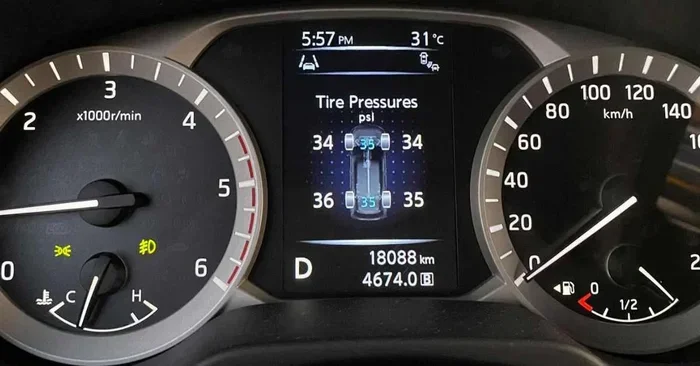
Your Nissan Altima also has a Tire Pressure Monitoring System, or TPMS. This system uses tire pressure sensors to alert you when pressure drops too low. The TPMS warning light looks like a horseshoe with an exclamation point. While the TPMS is helpful, it only activates when pressure is significantly low. A manual check catches problems before the light comes on.
Step-by-Step Guide to Checking Tire Pressure on a Nissan Altima
Now that you have your tools and know the right pressure, let us walk through the process. Follow these steps in order for the most accurate results.
Step 1: Check Tires When They Are Cold
Drive less than a mile or wait at least three hours after driving before you check. Tires heat up when you drive, and the air inside expands. A hot tire gives a falsely high reading. Cold tires give you the most accurate pressure measurement.
If you must check on the go, make sure the car has been parked for at least 30 minutes. This gives the air inside the tire time to cool down.
Step 2: Remove the Valve Stem Cap
Each tire has a small valve stem. It looks like a tiny rubber or metal cap sticking out of the wheel. Twist the cap counterclockwise to remove it. Set the cap aside in a safe place. You will put it back on when you are done.
Step 3: Press the Gauge Firmly onto the Valve Stem
Place your tire pressure gauge squarely onto the valve stem. Push down firmly and quickly. You should hear a brief hiss of air. This is normal. If you hear air leaking continuously, the gauge is not seated properly. Reposition it and try again.
Step 4: Read the Pressure
Look at your gauge to see the current pressure reading. A digital gauge shows the number on its screen. An analog gauge shows the number on the marked stick.
Compare this number to the recommended pressure from your door jamb sticker. If the reading matches, your tire is properly inflated. If it is low, you need to add air. If it is high, you need to release some air.
Step 5: Add or Release Air as Needed
If the pressure is low, use an air compressor or gas station pump to add air. Hold the nozzle firmly against the valve stem. Add air in short bursts. Check the pressure after each burst to avoid overinflating.
If the pressure is too high, press the small pin inside the valve stem to release air. Use a small tool like a pen cap to press it. Check the pressure again after releasing a little air.
Step 6: Replace the Valve Stem Cap
Once the pressure is correct, put the valve stem cap back on. Twist it clockwise until it is snug. The cap keeps dirt and moisture out of the valve stem. Losing the cap can lead to slow air leaks over time.
Step 7: Repeat for All Four Tires
Do this for every tire, including the spare if your Altima has one. Some spare tires require a different pressure than the regular tires. Check your owner manual for spare tire specifications.
Common Tire Pressure Mistakes and How to Avoid Them
Even experienced drivers make mistakes when checking tire pressure. Here are the most common errors and how to avoid them.
Relying Only on the TPMS Light
Your Nissan Altima’s TPMS is a great safety feature. But it only activates when pressure drops 25 percent or more below the recommended level. By the time the light comes on, your tire is already significantly underinflated. This is why regular manual checks matter.
Think of the TPMS as a backup system, not your primary tool. Use it alongside regular manual checks for the best results.
Checking Tires After Driving
As mentioned earlier, hot tires give inaccurate readings. Many people check their tires right after a long drive. The reading will be higher than the actual cold pressure. This can lead to letting too much air out of the tire.
Make it a habit to check in the morning before you drive. Or wait at least three hours after your last trip.
Using the Wrong Number
The number on the tire sidewall is the maximum pressure, not the recommended pressure. Using this number can cause overinflation. Overinflated tires wear the center of the tread faster and give a harsher ride.
Always use the number from the door jamb sticker or owner manual. That is the number designed for your Altima’s weight, handling, and comfort.
Ignoring the Spare Tire
Flat tires happen at the worst times. If your spare tire is also underinflated, you are stuck with no backup. Check your spare tire pressure at least twice a year. Replace the spare if it is more than 10 years old, even if it has never been used.
How Often Should You Check Tire Pressure?
Most experts recommend checking tire pressure at least once a month. Tires naturally lose about 1 psi of pressure per month. Temperature changes also affect pressure. For every 10-degree drop in outside temperature, your tires can lose about 1 psi.
Make it part of your routine. Some drivers check their tires every time they fill up with gas. Others set a reminder on their phone for the first day of each month. Find a schedule that works for you and stick with it.
Also check your tire pressure before long road trips. A pre-trip check takes just a few minutes but can prevent problems on the highway. If you are planning a trip, consider checking your how to read abs codes without a scanner before you go as part of a full vehicle health check.
Regular tire pressure checks pair well with other routine maintenance tasks. For example, keeping your car’s interior clean and protecting your dashboard can complement your overall car care routine, similar to how to care for your auto tint to maintain your vehicle’s appearance and value.
When to See a Professional
Most tire pressure checks are simple DIY tasks. But there are times when professional help is the right call.
- Your TPMS light stays on after you inflate your tires: This could indicate a faulty tire pressure sensor or a slow leak that needs professional diagnosis.
- You notice a tire losing pressure frequently: A slow leak could mean a puncture, a damaged valve stem, or a problem with the rim seal. A tire shop can find and fix these issues.
- You are unsure about the correct pressure for your model: If you cannot find the door jamb sticker or owner manual, a Nissan dealer can look up the specifications for your specific Altima.
A professional tire shop can also perform a full tire inspection. They check the tread depth, look for uneven wear patterns, and make sure your wheels are properly aligned. These checks go beyond tire pressure but are important for overall tire health.
Key Takeaways
- Check tire pressure monthly: Tires lose about 1 psi per month, so regular checks keep you safe and save fuel.
- Use the door jamb sticker for the correct psi: Never rely on the tire sidewall number or a friend’s recommendation.
- Check when tires are cold: Wait at least three hours after driving for the most accurate reading.
- A simple gauge is all you need: A digital or analog tire pressure gauge costs under $25 and works perfectly.
- Do not ignore the TPMS light: But also do not rely on it alone. Manual catches problems early.
- Don’t forget the spare tire: A flat spare defeats the purpose of having one in the first place.
Checking tire pressure on your Nissan Altima is one of the easiest ways to take care of your car. It takes just a few minutes, costs almost nothing, and pays off in safety, comfort, and fuel savings. Make it a regular habit and your Altima will reward you with a smoother, safer ride for years to come.
If you want to learn more about maintaining your Nissan Altima, understanding your vehicle’s fuel requirements can also help you make smarter choices. Check out our guide on can a Nissan Altima use unleaded 88 gas to see if your Altima can take advantage of higher-octane fuel options.
Proper tire care also connects to broader vehicle maintenance habits. Regular diagnostics, such as reading ABS codes without a scanner, help you catch issues early before they become expensive repairs. And when you are caring for your car inside and out, protecting your auto tint is just another way to preserve your Altima’s value and appearance over time.
Take five minutes today. Grab your gauge. Check your tires. It is one of the simplest things you can do for your Nissan Altima, and it makes a bigger difference than you might think.
Frequently Asked Questions
What is the recommended tire pressure for a Nissan Altima?
Most Nissan Altima models recommend a tire pressure of around 32 psi. However, the exact number varies by model year and trim. Always check the sticker on your driver’s door jamb or your owner manual for the correct specification.
Can I check my tire pressure at a gas station?
Yes, you can. Most gas stations have air pumps you can use. Bring your own tire pressure gauge for the most accurate reading, since the built-in gauges at pumps are often not precise.
How often should I check my Nissan Altima tire pressure?
Check your tire pressure at least once a month. Tires lose about 1 psi of pressure each month naturally. Also check before long road trips and after significant temperature changes.
Why is my tire pressure light on even though my tires look fine?
The TPMS light can come on due to a slow leak, a faulty tire pressure sensor, or a sudden temperature drop. Even if the tires look fine to the eye, the pressure may be low enough to trigger the warning. Use a manual gauge to verify the actual pressure.
Is it safe to drive with low tire pressure?
Driving with low tire pressure is not safe. It reduces handling, increases stopping distance, and raises the risk of a blowout. If your tire pressure is low, add air as soon as possible. If the TPMS light is on, check your tires right away.
What happens if I overinflate my tires?
Overinflated tires ride harshly and wear the center of the tread faster. They also have less contact with the road, which reduces grip, especially on wet surfaces. Always inflate to the pressure listed on your door jamb sticker, not the maximum number on the tire sidewall.