Do You Have to Press the Accelerator with Cruise Control
You do not need to press the accelerator when cruise control is active. Once you set your desired speed, the system manages the throttle automatically. However, you may need to tap the accelerator in certain situations, like hills or when adjusting speed. Understanding how cruise control works can save fuel, reduce fatigue, and make long drives more comfortable.
Have you ever been on a long highway drive and wondered whether you need to keep your foot on the accelerator? If you use cruise control, the answer is simple: you do not need to press the pedal at all. The system takes over throttle management and keeps your vehicle moving at a steady pace.
But here is the twist. There are situations where a light tap on the accelerator makes sense. Maybe you are climbing a steep hill. Or perhaps traffic is slowing down ahead. Understanding when and how to interact with your cruise control system can make a huge difference in comfort, safety, and fuel economy.
In this guide, we will break down everything you need to know. We will cover how cruise control works, when to use it, when to override it, and the differences between traditional systems and modern adaptive cruise control. By the end, you will feel confident using cruise control on any road trip.
Key Takeaways
- No pedal input needed: Cruise control maintains your set speed without pressing the accelerator.
- Adaptive systems are smarter: They adjust speed based on traffic and road conditions automatically.
- You still stay in control: The driver is always responsible for braking and steering.
- Use it on highways: Cruise control works best on flat, open roads with steady traffic flow.
- Know when to override: Hills, curves, and wet roads may require manual pedal input.
- Fuel savings are real: Steady speed means better fuel efficiency over long trips.
- Avoid common mistakes: Don’t use cruise control in heavy traffic or bad weather.
📑 Table of Contents
- How Cruise Control Actually Works
- When You Do Not Need to Touch the Accelerator
- When You Must Press the Accelerator
- Adaptive Cruise Control vs. Traditional Cruise Control
- Common Cruise Control Mistakes and How to Avoid Them
- Expert Tips for Using Cruise Control Safely
- The Future of Cruise Control and Driver Assistance
How Cruise Control Actually Works
Many drivers use cruise control every day without fully understanding what happens under the hood. Let us break it down in simple terms. Your cruise control system is essentially a speed regulator. It uses sensors and electronic controls to maintain a constant vehicle speed without any input from your right foot.
The Basic Mechanism
When you activate cruise control, the system communicates with your car’s engine control unit. It adjusts the throttle position to keep the wheels spinning at your chosen set speed. Think of it like a smart throttle that holds its position.
Here is what happens step by step:
- You accelerate to your desired speed using the gas pedal.
- You press the cruise control button on the steering wheel or stalk.
- The system locks in that speed and takes over throttle control.
- Your foot can now rest away from the accelerator pedal.
That is it. The system handles the rest. Your car will maintain the same pace until you tap the brakes, press the cancel button, or adjust the speed manually.
What Controls the Throttle?
The throttle control in a cruise control system is managed electronically in most modern vehicles. Older cars used a cable-connected throttle, but today’s vehicles rely on electronic sensors. These sensors monitor road conditions, engine load, and vehicle speed to make real-time adjustments.
This means your cruise control can compensate for small changes in wind resistance or road gradient. It is smarter than most people give it credit for. But it is not perfect, which brings us to our next point.
When You Do Not Need to Touch the Accelerator
There are plenty of driving situations where cruise control works perfectly on its own. Knowing these scenarios helps you relax behind the wheel and enjoy the ride.
Long Highway Drives
Highway driving is where cruise control shines the most. When you are cruising at a steady speed limit on a long, flat stretch of road, the system handles everything beautifully. Your fuel efficiency can actually improve because the system avoids unnecessary acceleration and deceleration.
Studies have shown that maintaining a consistent speed reduces fuel consumption by up to 15 percent on highway trips. That is a nice bonus for your wallet.
Open Roads with Steady Traffic Flow
If you are driving on a road with smooth, predictable traffic, cruise control works great. The key word is predictable. When cars around you are moving at a similar pace and there are no sudden stops, you can let the system do its job.
Flat Terrain
Flat or gently rolling roads are ideal for cruise control. The system does not have to work hard to maintain speed, so your engine runs efficiently. This is the sweet spot for using cruise control settings.
Quick Tips for These Situations
- Set your speed at or slightly below the posted speed limit.
- Use the resume function after passing slower vehicles.
- Keep a safe following distance even with cruise control active.
- Stay alert and keep both hands on the steering wheel.
When You Must Press the Accelerator
Here is where things get important. Cruise control is a convenience feature, not an autopilot system. There are specific situations where you will need to use the acceleration pedal manually.
Driving Uphill or on Steep Grades
This is the number one situation where you need to think about pressing the accelerator. When your car hits a steep incline, the cruise control system may struggle to maintain speed. The engine works harder against gravity, and the throttle may not provide enough power on its own.
In older vehicles, you might notice the engine revving loudly but the speed dropping. In modern cars, the system may downshift automatically, but it still might not hold your set speed on very steep hills. A light tap on the accelerator helps the system recover.
Sudden Traffic Slowdowns
Traditional cruise control does not slow down on its own when traffic ahead of you slows. You must press the brake pedal to deactivate the system. However, if you need to speed up briefly to merge or adjust your position, a quick tap on the acceleration pedal works without canceling the entire system.
Wind Resistance and Headwinds
Strong headwinds can slow your vehicle down even with cruise control active. The system tries to compensate, but sometimes a gentle press of the accelerator helps maintain your pace. This is especially true for taller vehicles like trucks and SUVs that catch more wind.
Merging and Passing
When you need to merge onto a highway or pass a slower vehicle, you want a quick burst of speed. Tapping the accelerator gives you that instant boost. Once you are done, the system will return to your set speed if you do not press the cancel button.
Common Mistakes to Avoid
- Do not use cruise control in heavy traffic. You need full pedal control in stop-and-go situations.
- Do not use it on wet or icy roads. Sudden speed changes can cause loss of traction.
- Do not rely on it in winding roads. Curves require speed adjustments that cruise control cannot handle well.
- Do not fall asleep at the wheel. Cruise control is not a substitute for attentive driving.
Adaptive Cruise Control vs. Traditional Cruise Control
If you have a newer vehicle, you might have adaptive cruise control. This is a significant upgrade from traditional systems. Let us compare the two so you understand what each one does.
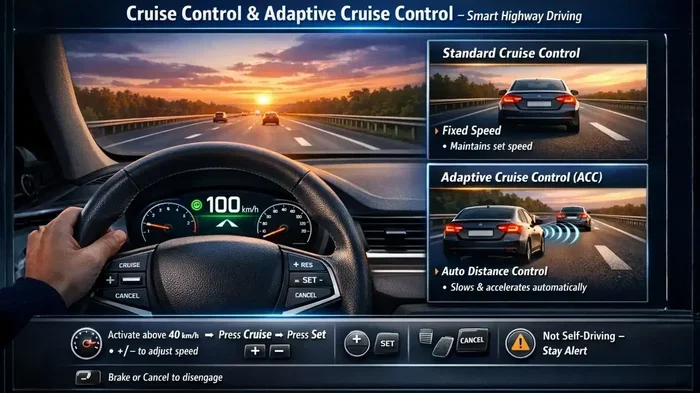
Traditional Cruise Control
Traditional cruise control maintains a fixed speed. It does not adjust for traffic, road conditions, or obstacles. You are responsible for braking, steering, and any speed changes. It works well on highways with steady flow but is limited in its capabilities.
Adaptive Cruise Control
Adaptive cruise control (ACC) uses radar, cameras, or sensors to detect vehicles ahead. It automatically adjusts your vehicle speed to maintain a safe following distance. When the car ahead slows down, your car slows down too. When the road clears, it accelerates back to your set speed.
This is a game changer for highway driving. You still do not need to press the accelerator in most situations, but the system handles speed adjustments on its own. Some advanced systems even bring the car to a complete stop and resume moving when traffic starts again.
Comparison Table
| Feature | Traditional Cruise Control | Adaptive Cruise Control |
|---|---|---|
| Maintains set speed | Yes | Yes |
| Adjusts for traffic | No | Yes |
| Automatic braking | No | Yes (in some systems) |
| Works in stop-and-go | No | Yes (in advanced systems) |
| Requires accelerator input | Sometimes (hills, passing) | Rarely |
| Best use case | Open highways, flat roads | All highway driving, heavy traffic |
| Driver responsibility | Full control | Partial control |
Which One Do You Need?
If you do a lot of highway driving in areas with heavy traffic, adaptive cruise control is worth the investment. If you mostly drive on open, flat highways, traditional cruise control still does the job well. Both systems reduce the need to press the acceleration pedal during normal driving conditions.
Common Cruise Control Mistakes and How to Avoid Them
Even experienced drivers make mistakes with cruise control. Let us look at the most common errors and how to fix them.
Mistake 1: Using It in Bad Weather
Rain, snow, and ice are enemies of cruise control. When your tires lose traction, the system does not know. It will keep trying to maintain speed, which can be dangerous. Always deactivate cruise control in poor weather conditions.
Mistake 2: Falling Asleep or Zoning Out
Cruise control can make drivers feel too relaxed. Some people take their hands off the wheel or their eyes off the road. This is extremely dangerous. The system does not steer the car. You must always stay engaged.
Mistake 3: Forgetting to Cancel Before Braking
When you need to slow down, tap the brake pedal first. This automatically cancels cruise control. Forgetting to do this can cause sudden acceleration when you least expect it, especially on downhill slopes.
Mistake 4: Setting Speed Too High
It is tempting to set cruise control at or above the speed limit. This increases the risk of tickets and accidents. Always set a safe and legal speed.
Quick Tips to Avoid Mistakes
- Always keep your hands on the steering wheel.
- Deactivate cruise control in rain, snow, or ice.
- Use the cancel button before making any manual speed changes.
- Set a reasonable set speed that matches road conditions.
- Stay alert and ready to take full control at any moment.
Expert Tips for Using Cruise Control Safely
We asked driving instructors and automotive experts for their best tips on using cruise control effectively. Here is what they had to say.
Tip 1: Use the Resume Function Wisely
After you tap the brake or cancel cruise control, you can press the resume button to return to your previous set speed. This is handy after passing a slower vehicle. Just make sure the road ahead is clear before resuming.
Tip 2: Adjust Speed for Road Conditions
Even on a highway, road conditions change. Construction zones, sharp curves, and merging lanes all require lower speeds. Manually adjust your cruise control settings to match the current conditions rather than relying on the system to do it for you.
Tip 3: Know Your Vehicle’s System
Every car is different. Take time to read your owner’s manual and understand exactly how your cruise control system works. Some vehicles have buttons on the steering wheel, while others use a stalk on the steering column. Knowing where every button is can save you from confusion on the road.
Tip 4: Combine Cruise Control with Fuel-Saving Habits
Cruise control helps maintain a steady throttle control, which improves fuel economy. Combine it with other habits like keeping your tires properly inflated and avoiding rapid acceleration. Together, these steps can significantly boost your fuel efficiency on long trips.
Tip 5: Use Cruise Control to Combat Fatigue
Long drives can be tiring. Cruise control reduces the need for constant throttle adjustments, which gives your right leg a break. However, it does not replace rest. Take breaks every two hours or so to stay fresh and alert.
Expert Insight
Driving instructors emphasize that cruise control is a tool, not a replacement for active driving. The system works best when the driver remains engaged and ready to take over at any moment. Always keep both hands on the wheel and your eyes on the road, even when cruise control is active.
The Future of Cruise Control and Driver Assistance
Automotive technology is evolving fast. What we call cruise control today is becoming more advanced every year. Adaptive cruise control is now standard on many new vehicles, and some brands offer fully integrated driver assistance systems that combine cruise control with lane-keeping and automatic braking.
In the near future, we may see systems that handle almost all highway driving tasks. But for now, the driver remains the most important safety component in any vehicle. Understanding how your current cruise control system works and when to use it is essential for safe driving.
Whether you drive a compact car, a full-size SUV, or a pickup truck, cruise control can make your trips more comfortable. Just remember to use it wisely and never let it replace your attention behind the wheel.
The bottom line is this. You do not have to press the accelerator when cruise control is active. But knowing when a light touch on the pedal helps, and when to keep your foot ready, is what separates a good driver from a great one. Stay informed, stay alert, and enjoy the ride.
Frequently Asked Questions
Do you have to press the accelerator when cruise control is on?
No, you do not need to press the accelerator when cruise control is active. The system automatically manages throttle to maintain your set speed. However, you may need to tap the accelerator in specific situations like steep hills or when passing other vehicles.
Can cruise control save fuel?
Yes, cruise control can improve fuel efficiency by maintaining a steady speed. This is especially true on long highway drives where constant acceleration and deceleration would otherwise waste fuel. Studies show savings of up to 15 percent on highway trips.
Is adaptive cruise control the same as traditional cruise control?
No, adaptive cruise control is more advanced. It uses sensors and cameras to detect vehicles ahead and automatically adjusts your speed to maintain a safe following distance. Traditional cruise control only maintains a fixed speed without adjusting for traffic.
Should you use cruise control in the rain?
No, it is best to avoid cruise control in wet or icy conditions. When roads are slippery, the system may not detect loss of traction. Always deactivate cruise control and maintain full manual control of your vehicle speed in bad weather.
What happens if you tap the brakes with cruise control on?
Tapping the brakes automatically cancels cruise control. This is a safety feature designed to give the driver immediate control. You can then press the resume button to return to your previous set speed once it is safe to do so.
Can you use cruise control on city streets?
It is not recommended to use cruise control in city driving or stop-and-go traffic. The system is designed for steady-speed highway driving. Using it in urban areas where frequent stopping is required can be unsafe and may cause unnecessary wear on the braking system.
=== CONCLUSION ===
So, do you have to press the accelerator when using cruise control? The short answer is no. Once you set your speed and activate the system, your right foot can rest comfortably. The cruise control system handles throttle management and keeps your vehicle moving at a consistent pace.
But the full answer is a bit more nuanced. There are times when a gentle tap on the acceleration pedal helps. Steep hills, strong headwinds, passing maneuvers, and merging situations all benefit from a bit of manual input. And with adaptive cruise control, many of these situations are handled automatically, making the driving experience even more seamless.
The key is understanding your vehicle’s system and using it appropriately. Cruise control is a fantastic tool for reducing fatigue and improving fuel efficiency on long drives. But it works best when paired with an attentive, engaged driver who knows when to step in and take control.
Next time you hit the highway, set your cruise control, relax your right foot, and enjoy the drive. Just keep your hands on the wheel, your eyes on the road, and your mind on driving. Safe travels!