Is Tesla a Non-Union Company Everything You Should Know
Tesla operates as a non-union company, meaning its workforce is not represented by a labor union. The electric vehicle maker has faced multiple unionization drives, but none have succeeded so far. Understanding Tesla’s labor landscape helps buyers, job seekers, and industry watchers grasp how this shapes production, wages, and worker experience.
Tesla has changed the car industry in big ways. But one question keeps coming up: is Tesla a non-union company? The short answer is yes. Tesla does not have a union representing its workers. This fact shapes how the company runs its factories, treats its employees, and handles labor disputes. Whether you are thinking about buying a Tesla, applying for a job there, or just curious about car industry labor, this guide covers everything you need to know.
Many people assume all automakers deal with unions. Companies like Ford and General Motors have long histories with organized labor. Tesla takes a very different path. The company was founded in 2003 and grew fast. It never signed a union contract. This makes Tesla stand out in the automotive world. Let us dig into what this means and why it matters.
Key Takeaways
- Tesla remains non-union: No labor union currently represents Tesla workers at any of its major facilities.
- Unionization attempts have failed: Multiple efforts, including the famous Fremont vote, did not result in union representation.
- Tesla offers unique benefits: The company provides stock options, flexible perks, and competitive pay to attract talent.
- Non-union status affects wages: Without collective bargaining, Tesla sets its own pay scales and policies.
- The future is uncertain: Growing labor movements in the auto industry could push Tesla toward union discussions again.
- Right-to-work laws matter: Tesla’s locations in states with right-to-work laws make unionizing harder.
- Worker experiences vary: Some employees praise Tesla culture, while others report demanding conditions.
📑 Table of Contents
- What Does It Mean for a Company to Be Non-Union?
- Tesla’s Labor History and Unionization Efforts
- How Tesla’s Non-Union Status Affects Workers
- Comparing Tesla to Unionized Automakers
- Why Tesla Stays Non-Union
- The Future of Unions at Tesla
- Quick Tips for Tesla Job Seekers
- Common Mistakes People Make About Tesla and Unions
- Expert Insights on Tesla’s Labor Model
- Final Thoughts
What Does It Mean for a Company to Be Non-Union?
A non-union company operates without any labor union representing its workers. This means employees do not have a collective bargaining agent. They negotiate pay, benefits, and working conditions directly with management. There is no middleman like a union standing between workers and the company.
In a unionized company, workers vote to form a union. The union then negotiates contracts on behalf of all employees. These contracts often cover wages, hours, safety rules, and grievance procedures. In a non-union company like Tesla, none of this happens. The company sets all these rules on its own.
Some people prefer non-union setups. They believe it gives companies more flexibility. Others argue unions protect workers better. The truth lies somewhere in between. It depends on the company culture and how management treats its team.
Tesla’s Labor History and Unionization Efforts
Tesla has a long and complicated history with unions. The company has faced several unionization drives over the years. Most of them have not succeeded. But each attempt tells us something about Tesla’s labor stance.
The Fremont Factory and Early Union Attempts
Tesla’s main factory sits in Fremont, California. This plant used to belong to General Motors and Toyota before Tesla bought it. Both of those legacy automakers had union contracts. When Tesla took over, it did not honor those unions. Tesla started fresh with a non-union workforce.
Workers at Fremont tried to organize early on. In 2017, the United Auto Workers (UAW) filed to hold a union vote. Tesla pushed back hard. The company told workers that a union would hurt the company. It also offered better pay and benefits to discourage union support. The vote never happened because not enough workers signed cards to trigger it.
Recent Union Votes and NLRB Involvement
The National Labor Relations Board (NLRB) has gotten involved with Tesla more than once. In 2022, a small group of Tesla workers in Buffalo, New York voted on unionizing. They rejected the union. The vote was close but not in favor of the union.
Tesla has also faced complaints about how it treats pro-union workers. The NLRB has ruled against Tesla in several cases. These rulings say Tesla violated labor laws by intimidating workers who supported unions. Despite these rulings, Tesla has not become unionized.
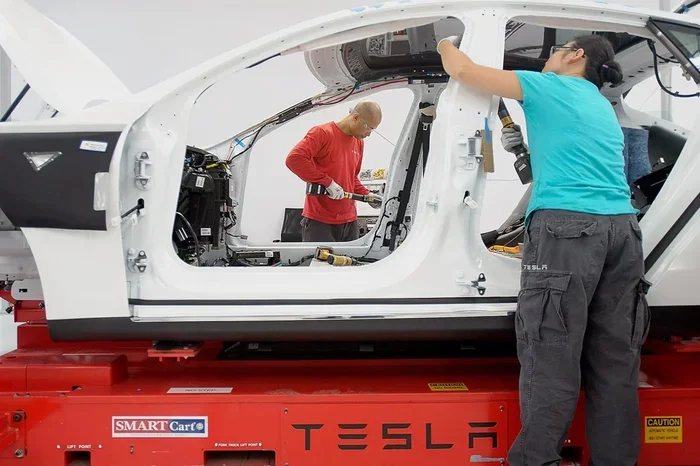
Building a car takes many man hours across different departments. When a company like Tesla operates without a union, it controls every part of that process. From assembly line workers to engineers, everyone works under Tesla’s direct rules. You can learn more about how many man hours go into building a car at how many man hours does it take to build a car.
How Tesla’s Non-Union Status Affects Workers
Being a non-union company affects Tesla workers in many ways. Some of these effects are positive. Others are more controversial. Let us break down the key impacts.
Pay and Benefits
Tesla offers competitive pay to its workers. The company knows it needs to attract talent in a tough job market. Without a union, Tesla sets its own wage scales. It can adjust pay based on performance, demand, and company profits.
Tesla also offers stock options to many employees. This is a big draw for tech-minded workers. The idea is that if Tesla succeeds, workers share in that success. Unionized automakers rarely offer stock options. They stick to fixed wage and benefit packages.
But critics say Tesla’s pay is not always fair. Without a union, workers cannot collectively bargain for raises. If Tesla decides to freeze wages, employees have little recourse. This power imbalance worries many labor advocates.
Working Conditions and Safety
Tesla factories are known for their speed. The company pushes to build cars as fast as possible. This fast-paced environment can be stressful. Some workers report long hours and tight deadlines.
Without a union, safety complaints go directly to management. There is no union steward to mediate. Tesla says it takes safety seriously. It has invested in factory upgrades and safety training. But workers who speak up about safety sometimes say they face pushback.
Tesla also has a reputation for demanding work culture. The company expects high output from every employee. This is part of the non-union model. Without collective bargaining agreements, Tesla can set its own productivity expectations.
You can explore how long a factory takes to build a car and what that means for worker demands at how long does a factory take to build a car.
Job Security and Termination
In a non-union company, employment is typically “at-will.” This means Tesla can fire workers for many reasons. It cannot fire workers for union activity. But outside of that protected category, Tesla has broad termination power.
Unionized workers enjoy more job security. Their contracts limit when and how they can be fired. Tesla workers do not have this protection. This creates a different kind of workplace dynamic. Some workers feel free to leave if they are unhappy. Others feel vulnerable.
Comparing Tesla to Unionized Automakers
To understand Tesla’s non-union status, it helps to compare it to other automakers. Most legacy car companies in the U.S. have strong unions. Ford, GM, and Stellantis all work with the UAW. Let us look at how they differ from Tesla.
| Factor | Tesla (Non-Union) | Ford/GM/Stellantis (Union) |
|---|---|---|
| Worker Representation | No union; direct with management | UAW represents workers |
| Wage Setting | Company decides | Collective bargaining |
| Benefits | Stock options, flexible perks | Fixed benefits packages |
| Job Security | At-will employment | Contract protections |
| Grievance Process | Internal HR process | Union grievance procedure |
| Production Speed | Very fast, high pressure | More structured pacing |
Tesla’s factory output is impressive. The company builds cars at a rapid pace. It produces hundreds of thousands of vehicles every year. This speed is possible partly because of the non-union model. Without union rules limiting shifts or pace, Tesla can run its factories around the clock.
You can see how many cars a factory produces daily at how many cars does a car factory make in a day. Tesla’s numbers are among the highest in the industry.
But speed comes at a cost. Unionized factories often have more predictable schedules. Workers know their hours and overtime rules. Tesla workers sometimes face unpredictable schedules and mandatory overtime. This trade-off between flexibility and worker protection is at the heart of the union debate.
Why Tesla Stays Non-Union
Tesla has several reasons for staying non-union. Understanding these reasons helps explain the company’s stance.
Elon Musk’s Anti-Union Stance
Elon Musk has been very vocal about his views on unions. He has called unions “unnecessary” and said they slow down innovation. Musk believes Tesla’s direct relationship with workers is better than a union middleman. He has used company resources to discourage union activity.
Musk’s influence on Tesla culture is huge. His anti-union stance trickles down through management. Workers who want to organize face an uphill battle. The company’s leadership makes it clear that unions are not welcome.
Location in Right-to-Work States
Tesla’s main factory is in California. But Tesla also has major plants in Texas and Nevada. All three of these states are right-to-work states. In right-to-work states, workers cannot be forced to join a union or pay union dues. This makes unionizing much harder.
Right-to-work laws give workers the choice to opt out of unions. While this sounds fair, it also weakens unions. Fewer workers pay dues, which means less money for organizing. Tesla benefits from this legal framework. It keeps the door closed on unionization at its facilities.
Company Culture and Philosophy
Tesla sees itself as a tech company, not just a car maker. This tech-company identity shapes its culture. Tech companies are typically non-union. Tesla wants to be seen as innovative and forward-thinking. Unions are often associated with traditional manufacturing. Tesla wants to distance itself from that image.
The company also believes in a mission-driven workforce. Tesla wants workers who are passionate about electric vehicles and sustainability. It thinks a union would distract from that mission. Instead, Tesla tries to inspire workers through the company’s bigger purpose.
The Future of Unions at Tesla
Will Tesla ever become unionized? The answer is uncertain. Several factors could push the company toward unions in the future.
The broader auto industry is seeing renewed labor interest. The UAW recently won big contracts with Ford, GM, and Stellantis. These wins show that unions can still win in the auto sector. Tesla workers are watching closely.
Tesla also faces growing scrutiny over worker conditions. Reports of long hours, low pay in some roles, and safety concerns keep making headlines. If these issues worsen, workers may feel more urgency to organize.
Tesla’s rapid expansion also creates new challenges. The company is building factories in Mexico, Germany, and elsewhere. Each new facility brings new labor dynamics. Tesla will need to decide how to handle unions at these international locations. Some countries require unions by law. Tesla will have to navigate these rules carefully.
For now, Tesla remains firmly non-union. The company’s leadership shows no signs of changing its position. Workers who want representation must rely on internal channels. Whether this changes in the coming years is anyone’s guess.
Quick Tips for Tesla Job Seekers
- Research factory conditions: Read worker reviews on sites like Glassdoor before applying.
- Understand your rights: Even without a union, federal labor laws protect you.
- Ask about benefits: Tesla’s stock options and benefits are unique perks worth understanding.
- Know the work pace: Tesla factories are fast-paced. Be honest with yourself about whether you can keep up.
- Stay informed: Follow Tesla labor news so you know if union efforts pick up.
Common Mistakes People Make About Tesla and Unions
- Assuming all car companies are unionized: Tesla is a clear exception in the industry.
- Thinking non-union means no worker protections: Federal laws still apply regardless of union status.
- Believing Tesla workers have no voice: Workers can still report issues through HR and government agencies.
- Overlooking international differences: Tesla factories in Europe may have different labor rules than U.S. plants.
Expert Insights on Tesla’s Labor Model
Labor experts have mixed views on Tesla’s non-union model. Some say it allows Tesla to innovate faster. Without union rules slowing down decisions, Tesla can adapt quickly. Others say it leaves workers vulnerable. Without collective bargaining, individual workers have less power.
Dr. Harley Shaiken, a labor historian at UC Berkeley, has studied Tesla’s labor practices closely. He notes that Tesla’s model is unusual among major automakers. Most legacy car companies accepted unions decades ago. Tesla’s refusal to do so is a key part of its identity.
On the other hand, Tesla supporters point to the company’s growth. Tesla has created thousands of jobs. It pays competitive wages in many roles. The company argues that its non-union model actually benefits workers by keeping the company profitable and growing.
Final Thoughts
Tesla is a non-union company, and that fact touches every part of its business. From factory floors to executive boardrooms, the absence of a union shapes how Tesla operates. Workers enjoy some unique benefits like stock options and fast career growth. But they also lack the protections and bargaining power that unions provide.
The debate over unions at Tesla is not going away. As the auto industry evolves, labor dynamics will shift too. Tesla’s non-union status may face more challenges in the years ahead. For now, the company remains a notable outlier in the world of car manufacturing. Understanding this helps you make smarter decisions as a consumer, job seeker, or industry observer.
Whether you support unions or not, Tesla’s labor story is worth following. It reflects bigger trends in the American workplace. The relationship between workers and companies is changing. Tesla sits right at the center of that change.
Frequently Asked Questions
Is Tesla a non-union company?
Yes, Tesla is a non-union company. No labor union currently represents Tesla workers at any of its major facilities. The company has consistently opposed unionization efforts.
Has Tesla ever been unionized?
No, Tesla has never been unionized. The company has faced multiple unionization drives, but none have succeeded. The Fremont factory, which Tesla acquired, previously had union contracts under GM and Toyota, but Tesla did not honor them.
Why does Tesla stay non-union?
Tesla stays non-union for several reasons. CEO Elon Musk has an anti-union stance. The company also operates in right-to-work states, which make unionizing harder. Tesla believes its direct relationship with workers is better than a union middleman.
Do Tesla workers have any protections without a union?
Yes, Tesla workers still have federal labor protections. The National Labor Relations Act protects workers’ rights to organize and discuss working conditions. However, without a union, workers cannot collectively bargain for wages or benefits.
Are Tesla workers paid less because the company is non-union?
Not necessarily. Tesla offers competitive pay and unique benefits like stock options. But without collective bargaining, workers cannot negotiate raises as a group. Some workers feel they lack leverage for wage increases compared to unionized automakers.
Could Tesla become unionized in the future?
It is possible. The broader auto industry is seeing renewed union interest. If worker conditions at Tesla worsen or if the labor movement gains more traction, Tesla workers may push harder for union representation. However, the company’s leadership shows no signs of welcoming a union.