Whats the Difference Between Dodge Charger and Challenger
The Dodge Charger is a full-size sedan with a bold, aggressive stance, while the Dodge Challenger is a classic two-door coupe with retro muscle car charm. Both models offer powerful engine options, spacious interiors, and iconic American styling, but they target different drivers. The Charger focuses on family-friendly practicality and four-door convenience, whereas the Challenger emphasizes pure muscle car nostalgia and rear-seat minimalism.
The Dodge Charger vs Challenger debate has been going on among car enthusiasts for years. Both are iconic American muscle cars from Dodge, but they are built on different platforms and serve different purposes. If you are trying to decide between these two legendary vehicles, you have come to the right place.
In this guide, we will break down every major difference between the Dodge Charger and the Dodge Challenger. We will look at body style, engine options, interior features, history, and which one suits your needs best. By the end, you will have a clear picture of which car deserves a spot in your garage.
Let us dive right in and explore what makes each of these Dodge models special. Whether you want a daily driver with muscle car power or a head-turning weekend cruiser, there is something here for you.
Key Takeaways
- Body Style: The Charger is a four-door sedan, while the Challenger is a two-door coupe.
- Engine Options: Both offer V6 and V8 choices, but the Challenger has more high-performance Hellcat variants.
- Interior Space: The Charger provides more rear-seat room and trunk space for families.
- Design Philosophy: The Charger has a modern aggressive look, while the Challenger leans into classic retro styling.
- Performance Trims: The Challenger offers more track-focused SRT and Hellcat models.
- Pricing: The Charger generally starts at a lower price point than the Challenger.
- Driving Experience: Both deliver thrilling performance, but the Challenger feels more like a true muscle car.
📑 Table of Contents
Body Style and Design Differences
The most obvious difference between the Dodge Charger and the Dodge Challenger is their body style. This is where the two cars split right from the start, and it shapes everything else about how they feel on the road.
The Charger’s Four-Door Sedan Design
The Dodge Charger is a full-size four-door sedan. That means it has two rows of seats and four doors for easy access. The design is sleek and aggressive, with a long hood and a sporty profile that screams muscle car without actually being one. The Charger blends sedan practicality with muscle car attitude.
Dodge designed the Charger to appeal to drivers who want performance and space. You get the look and feel of a performance car, but you also get a trunk that can fit luggage and a back seat that real people can sit in comfortably. This makes the Charger a great choice for families or anyone who needs a daily driver with some extra punch.
The Challenger’s Classic Coupe Look
The Dodge Challenger is a two-door coupe with a design that pays homage to the classic muscle cars of the 1960s and 1970s. It has a shorter wheelbase, a roofline that slopes gently backward, and a stance that looks like it came straight out of a time machine. The Challenger is pure nostalgia wrapped in modern technology.
Because the Challenger is a coupe, it only has two doors and a smaller rear seat. The back seat is tight and best used for storing bags or small items rather than full-sized adults. However, the front seats are spacious and comfortable, and the trunk, while not huge, handles everyday needs well. The retro design gives the Challenger a personality that the Charger simply cannot match.
Exterior Styling Details
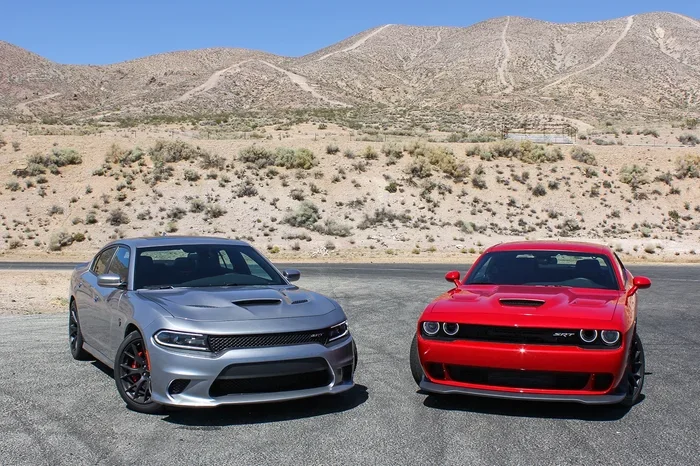
Both cars share Dodge’s bold design language, but they express it differently. The Charger features a wide stance, aggressive front grille, and full-width taillights that give it a modern muscle car look. The Challenger has rounder headlights, a more rounded body, and classic muscle car proportions that remind you of the original 1966 Charger and 1970 Challenger.
When you park these two side by side, they look like they belong to different eras. The Charger looks like it belongs on a police cruiser or a suburban street. The Challenger looks like it belongs at a car show or a weekend cruise. Both turn heads, but they do it in very different ways.
Performance and Engine Options
Now let us talk about the part that really matters to most enthusiasts: performance. Both the Dodge Charger and the Dodge Challenger offer a range of engines that cater to different driving styles and budgets.
Engine Lineup Comparison
The base engine for both cars is a 3.6-liter V6 that produces around 292 horsepower. This is plenty of power for daily driving and highway cruising. However, the real magic happens when you step up to the V8 options.
The Charger offers a 5.7-liter HEMI V8 with 370 horsepower as its top option in most trims. The Challenger also offers this engine, but it goes further with the supercharged 6.2-liter HEMI V8 in the Hellcat and Super Stock models, which produce a staggering 717 to 807 horsepower. The Challenger has more high-performance variants than the Charger.
Here is a quick look at the engine options available:
- 3.6L V6: 292 hp, available in both models
- 5.7L HEMI V8: 370 hp, available in both models
- 6.4L HEMI V8: 485 hp, available in both models
- 6.2L Supercharged HEMI V8 (Hellcat): 717 hp, Challenger only
- 6.2L Supercharged HEMI V8 (Super Stock): 807 hp, Challenger only
- 6.2L Supercharged HEMI V8 (Demonic): 1,025 hp, Challenger only
Driving Feel and Handling
The Charger feels more like a large performance sedan. It rides smoother, handles more predictably, and feels stable at highway speeds. The Challenger feels more raw and engaging. It has a tighter turning circle and feels more agile for a car its size. Both cars use rear-wheel drive as standard, and all-wheel drive is available as an option in both models.
If you want a car that can handle daily commutes and weekend road trips with ease, the Charger is the better choice. If you want a car that makes you feel alive every time you twist the key, the Challenger is hard to beat.
Performance Trims: R/T, SRT, and Hellcat
Dodge offers several performance trims for both cars. The R/T trim comes with the 5.7-liter HEMI V8 and is a great sweet spot for enthusiasts who want serious power without going overboard. The SRT trim steps up to the 6.4-liter V8 and adds track-ready suspension and brakes.
The Hellcat is where things get truly wild. The Challenger Hellcat is one of the most powerful production cars ever made. It is a brute force machine that can do things most cars can only dream of. The Charger also has a Hellcat variant, but the Challenger Hellcat is the more iconic and sought-after version.
One thing worth noting: when you are dealing with this much power, you need to be careful. These cars are not forgiving, and they demand respect on the road. Always drive within your limits and be mindful of road conditions.
Interior Space and Comfort
Inside, the Dodge Charger and Dodge Challenger offer very different experiences. The difference comes down to their fundamental design as a sedan versus a coupe.
Chargers Spacious Interior
The Charger’s four-door design gives it a significant advantage in interior space. The rear seats can comfortably seat three adults, and the legroom is generous. The trunk is large enough to fit multiple suitcases or golf bags with ease. The Charger is a practical car that can handle family duties without sacrificing performance.
The front seats are supportive and comfortable, with plenty of adjustment options. The cabin has roomy door pockets and a center console that can hold drinks and small items. Dodge has done a good job of making the Charger feel upscale despite its size, with available leather seating, heated and ventilated front seats, and a premium sound system.
Challengers Cozy Cockpit
The Challenger’s interior is designed with the driver in mind. The front seats are plush and supportive, and the cabin has a driver-focused layout. However, the rear seat is cramped and best suited for children or occasional use. The Challenger is a driver’s car first and foremost.
The trunk space is smaller than the Charger’s, but it is still usable for everyday needs. The interior has a retro-inspired design with round gauges and a classic center console layout that gives it a unique character. Available features include heated seats, an upgraded infotainment system, and performance-oriented gauges.
Technology and Infotainment
Both cars come with Dodge’s Uconnect infotainment system, which features a large touchscreen display, Apple CarPlay, Android Auto, and Bluetooth connectivity. The system is intuitive and easy to use, even while driving. Higher trims offer additional features like a navigation system, a premium Bose audio system, and a head-up display.
The Charger may have a slight edge in technology because it is positioned as a more premium sedan. However, the Challenger’s tech offerings are very similar, and both cars are well-equipped for their price range.
History and Heritage
Understanding the history of these two models helps you appreciate what makes each one special. Both the Charger and the Challenger have deep roots in American automotive culture.
The Chargers Legacy
The Dodge Charger was first introduced in 1966 as a mid-size coupe. It quickly gained fame as a stylish and powerful car that captured the spirit of the muscle car era. The second-generation Charger from 1968 became iconic thanks to the TV show “The Dukes of Hazzard,” where the famous General Lee Charger became a pop culture legend.
Dodge revived the Charger nameplate in 2006 as a full-size sedan, bringing back the four-door muscle car concept. The modern Charger has been a hit with police departments and car enthusiasts alike. It is one of the last remaining four-door muscle sedans on the market, which gives it a unique place in automotive history.
Interestingly, the modern Charger shares its platform with the Mercedes-Benz E-Class, which means it benefits from advanced engineering and a refined ride quality that many pure muscle cars lack.
The Challengers Heritage
The Dodge Challenger was introduced in 1970 as a direct competitor to the Ford Mustang and Chevrolet Camaro. It was a classic American muscle car with long hood, short rear deck proportions and a range of powerful engines. The Challenger became a symbol of the muscle car golden era and remains one of the most beloved cars from that period.
Dodge brought the Challenger back in 2008 for the 2009 model year, and it has been in production ever since. The modern Challenger is built on the Mercedes-Benz GL platform and shares its platform with the Jeep Grand Cherokee and the Dodge Durango. This gives it a solid foundation and modern safety features while maintaining its classic muscle car character.
The Challenger is the last of the traditional two-door muscle cars from the Big Three American automakers. When you buy a Challenger, you are buying a piece of automotive history that keeps getting better with each generation.
How These Cars Are Built
Both the Charger and the Challenger are assembled at Dodge’s Brampton Assembly plant in Ontario, Canada. It takes a significant number of man hours to build a car, and these Dodges are no exception. Each vehicle goes through a careful assembly process that ensures quality and consistency.
The manufacturing process involves stamping, welding, painting, and final assembly. Every car is inspected thoroughly before it leaves the factory. Knowing that these cars are built with care by skilled workers adds to the appeal of owning a Dodge muscle car.
Which One Should You Choose?
Choosing between the Dodge Charger and the Dodge Challenger comes down to your priorities and lifestyle. Both are excellent cars, but they serve different needs.
Choose the Charger If
- You need a practical daily driver with room for passengers and cargo
- You want a four-door muscle car that can do it all
- You prefer a smoother, more refined ride quality
- You need a car that can handle family trips and errands
- You want a lower starting price with strong performance
Choose the Challenger If
- You want a pure muscle car experience with retro styling
- You prioritize driving fun and track performance
- You do not need rear-seat space for regular use
- You want the most powerful engine options, including the Hellcat
- You love the classic two-door coupe look and feel
A Final Word on Dashboard Warning Lights
No matter which car you choose, it is important to understand your dashboard warning lights. If you see the check engine light or maintenance required light come on, do not ignore it. These lights can indicate serious issues that need immediate attention. A bad battery can cause the wrench light to come on in some cases, so it is always worth checking the basics first before panicking.
Taking care of your Dodge Charger or Challenger with regular maintenance will keep it running strong for years to come. Both cars are built to last and deliver exciting performance, but they need proper care to stay at their best.
Conclusion
The Dodge Charger vs Challenger debate is not about which car is objectively better. It is about which car fits your life and your driving goals better. The Charger is the practical choice for those who need space, comfort, and performance in one package. The Challenger is the passionate choice for those who want the purest muscle car experience available today.
Both cars represent the best of American muscle car engineering. They offer powerful engines, bold styling, and a driving experience that few other cars can match. Whether you choose the Charger or the Challenger, you are getting a car that turns heads and delivers thrills every time you get behind the wheel.
Take your time, test drive both models, and pick the one that speaks to you. Whichever you choose, you are getting a piece of automotive history that will give you years of enjoyment. And that is what owning a Dodge is all about.
Frequently Asked Questions
Is the Dodge Charger a muscle car or a sedan?
The Dodge Charger is technically a full-size sedan, but it is built with muscle car DNA. It offers V6 and V8 engine options and a sporty design that gives it the look and feel of a performance car. Many enthusiasts consider it a four-door muscle car, which is exactly what Dodge intended when they revived the nameplate in 2006.
Which is faster, the Dodge Charger or the Challenger?
On paper, the top-spec Challenger Hellcat is faster than the top-spec Charger Hellcat. The Challenger has more high-performance trims and a more track-focused design. However, the Charger Hellcat is still extremely fast and can compete with most sports cars on the road. The difference is small, and both will feel incredibly quick to the driver.
Can the Dodge Charger fit a family comfortably?
Yes, the Dodge Charger is one of the best muscle cars for families. It has four doors, a spacious rear seat, and a large trunk. The front seats are comfortable for tall drivers, and the cabin offers plenty of room for passengers. Families who want performance and practicality will find the Charger to be an excellent choice.
Is the Dodge Challenger hard to drive every day?
The Challenger is surprisingly easy to drive every day, especially with the available all-wheel drive system. The ride is comfortable, the infotainment system is user-friendly, and the seats are supportive. The main challenge is the tight rear seat and smaller trunk, which may not suit everyone’s needs. But for solo drivers or couples, it is a great daily driver.
Which Dodge has better fuel economy, the Charger or the Challenger?
The Dodge Charger tends to have slightly better fuel economy than the Dodge Challenger, mainly because it is built on a platform designed for a more refined ride. The base V6 engines in both cars get similar mileage, but the Charger’s larger size and sedan aerodynamics give it a small edge. Keep in mind that V8 models in either car will have lower fuel economy.
Are Dodge Chargers and Challengers reliable cars?
Both the Charger and Challenger have average reliability ratings for their class. Common issues include electrical gremlins and occasional transmission concerns, but overall they are solid cars with strong engines. Regular maintenance and prompt attention to warning lights will help keep either car running smoothly for many miles.